Feestelijke verkenningstocht . . (Festive exploration)

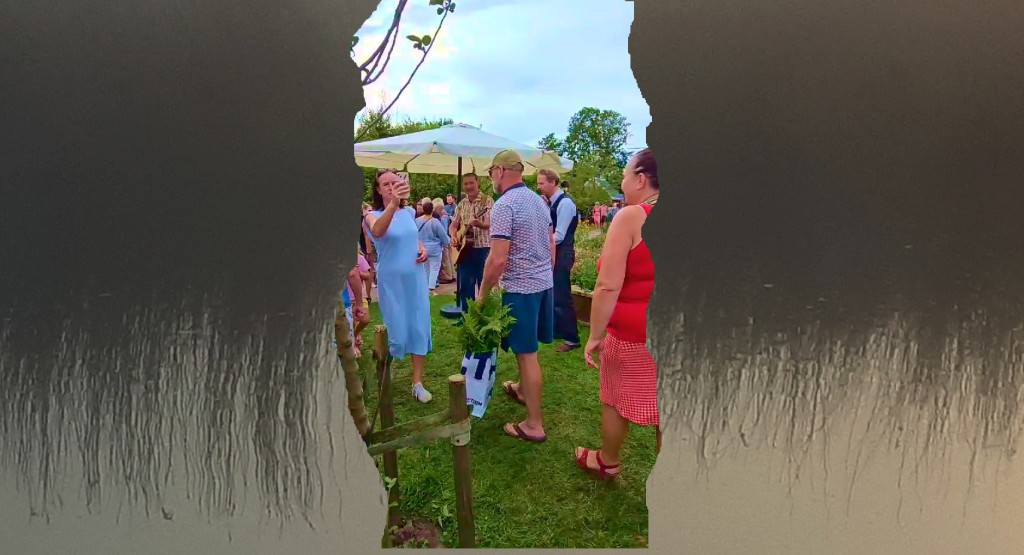
Mensen op het oogstfeest doorbreken het weerspiegelde riet in de ochtendmist. Het is zoals elke dag, het begint en eindigt met stilte en daartussen gebeurt het.

.
.

Liever luisteren? Klik op de knop onderaan de tekst.

Do you like to read the ENGLISH translation? You can find it underneath.

Het is nog vroeg. In de ochtendschemering hangt de mist over de weilanden. Zo vroeg is het, dat alles zwijgt in de vochtige lucht. Het Verhalenpad ligt er stil bij, geen torenvalken zweven er, geen zwaluwen scheren kwebbelend langs de bult. Ook de zwerm mussen is er niet en de puttertjes hangen nog niet in de kaardebollen. Ik kom uit mijn wagen, net wakker. Ik kijk om me heen. Het belooft een zonnige dag te worden. In mijn pyjama kruip ik langs het schot, waar de koekoeksbloem tegenaan hangt. Een spinnenweb kleeft in mijn gezicht. Dezelfde spin, hetzelfde plekje, tussen de wand en dat loshangende draadje. Vandaag ga ik niet naar mijn opgroeiende sprookjesbos. Vandaag ga ik er op uit. Ik ga naar het oogstfeest in Snakkerbuorren. Daar heb ik al veel van gehoord. Er zijn schilders aan het werk, er is live muziek en er is zelfgebakken taart. Daar houd ik van. Alledrie.

Ze staat in een hoekje achteraf, vlak bij het winkeltje. Op haar doek zie je een schuurtje, gezellig in de zonneschijn. Het hout is grijs geworden. Hetzelfde schuurtje zie ik aan het einde van de steeg. De lucht is stralend blauw, maar zij heeft er een donkere wolkenlucht van gemaakt. Het steegje licht stralend op tegen dat duister. Een roodbruine middenkleur vormt de ondergrond. “Ja, ik houd van die kleur, om mee te beginnen,” zegt ze als ik ernaar vraag. Ik stel allerlei vragen en de vrouw antwoordt met plezier. “Ik wil niet alleen maar naschilderen.” zegt ze. “Ik wil het nu wel eens vanuit mezelf. Iets creëeren wat er nog niet was. Meer dan alleen een plaatje…”
Verderop staat een man met een zelfgemaakte ezel. Het palet is ook eigen fabrikaat. Groot en wit is het. Met een heleboel kleine kloddertjes erop. Het ding glimt van nieuwigheid. “Ze zijn altijd te klein,” zegt hij. Ik knik begrijpend. “Zelf maken dus. Dat knoop ik in mijn oren,” zeg ik en loop verder.
Een stuk verderop hoor ik zingen. “Country road, take me home….” Het zijn lage vrouwenstemmen. Ik loop erheen en zing er helder bovenuit. Fijn als je mezzo bent, dan kan je kiezen, laag of hoog. Onder de zangers is een stevige zwarte vrouw. Ik kijk haar aan terwijl ik uit volle borst de tweede stem zing: “West Virginia, mountain mama” Ik kijk naar haar en zij naar mij. We gaan er allebei van stralen.

Na de hele zomer werken is het goed toeven op dit oogstfeest. Ik voer het ene gesprek na het andere, tot het me te druk wordt. Een dikke stroom mensen golft naar binnen terwijl ik mijn fietsslot openmaak om weg te gaan. En terwijl ik dertien kilometer terug fiets, denk ik aan de liedjes en schetsen die ik thuis heb liggen. Ja, denk ik. Ik ga ermee door. Liedjes van beelden maken, beelden van liedjes. Putten uit het grote palet van kleur en klank, putten uit de bron van verleden, heden en toekomst. Alles begint bij de verbeelding. Zonder verbeelding zijn we niets anders dan de slaaf der gewoonte. Een sprong kan je niet maken, als je je het niet eerst hebt voorgesteld. Als je spieren zich niet hebben voorbereid op de inspanning. Je ogen schatten de afstand, en jij maakt je klaar. Dat kan lang of kort duren. En ik, ik schilder een lied ter bemoediging. Voor de ander, voor mezelf, voor alles. Alleen en met elkaar. De wereld heeft kunst nodig.

Thuis kwetteren de mussen boven de voedertafel. Koolwitjes fladderen boven het raapzaad, vliegen omhoog de lucht in, maar komen steeds weer terug. Net als ik. Steeds weer terug. Eigen haard is goud waard..

Liedje: Onder mijn bed. (Song)

Het verhaal.

.

FESTIVE EXPLORATION

It’s still early. In the morning twilight the fog hangs over the meadows. It is so early that everything is silent in the damp air. The Story Path is quiet, no kestrels hover, no swallows skim chattering along the hump. The swarm of sparrows is not there either and the goldfinches are not yet hanging in the teasels. I got out of my car, just woke up. I look around. It promises to be a sunny day. In my pajamas I crawl along the bulkhead, where the cuckoo flower hangs against. A spider web sticks to my face. The same spider, the same spot, between the wall and that dangling thread. Today I am not going to my growing up fairy forest. Today I’m going out. I’m going to the harvest festival in Snakkerbuorren. I’ve heard a lot about that. There are painters at work, there is live music and there is homemade cake. I love that. All three.

She is standing in a corner at the back, near the greengrocer. On her canvas you see a shed, cozy in the sunshine. The wood has turned gray. I see the same shed at the end of the alley. The sky is bright blue, but she has turned it into a dark cloudy sky. The alley glows radiantly against that darkness. A red-brown middle color forms the background. “Yes, I like that color, to begin with,” she says when I ask. I ask all kinds of questions and the woman answers with pleasure. “I don’t just want to repaint.” she says. “I want to do it on my own now, in the future. Create something that wasn’t there before. More than just a picture…”
Ahead is a man with a self-made donkey. The palette is also own manufacture. It is big and white. With a lot of little blobs on it. The thing gleams with novelty. “They are always too small,” he says. I nod understandingly. “So make it yourself. I’ll tie that in my ears,” I say and walk on.
A little further on I hear singing. “Country road, take me home….” They are low female voices. I walk over and sing clearly above it. Great if you are mezzo, then you can choose, low or high. Among the singers is a big black woman. I look at her as I sing the second voice: “West Virginia, mountain mama” I look at her and she at me. We both shine.

After working all summer, it is good to relax at this harvest festival. I have one conversation after another, until it gets too crowded. A thick flod of people streams in as I open my bike lock to leave. And as I cycle thirteen kilometers back, I think of the songs and sketches I have lying around at home. Yes I think. I am going to do it. Making songs from images, images from songs. Drawing from the large palette of color and sound, drawing from the source of past, present and future. Everything starts with the imagination. Without imagination we are nothing but the slaves of habit. You can’t make a leap if you haven’t imagined it first. If your muscles have not prepared for the effort. Your eyes estimate the distance, and you get ready. That can take a long or short time. And me, I paint a song of encouragement. For the other, for myself, for everything. Alone and with each other. The world needs art.

At home, the sparrows chatter above the feeding table. Cabbage whites flutter above the rapeseed, fly up into the air, but keep coming back. Like me. Coming back, again and again. Your home is your castle.

Een duppie voor vrede . . . (A penny for peace)

Mijn vriend en ik rusten naast een fontein.

.

.

Liever luisteren? Klik op de knop onderaan de tekst.

Do you like to read the ENGLISH translation? Click on the button underneath.

.

Ik ben altijd blij als het regenachtig weer is. Af en toe een bui, mooie wolkenluchten, niet te warm, het is dan zo heerlijk buiten! Het is vreemd dat er niet meer mensen van genieten. Dat vindt Chief Dadá ook. Hij is een van de opperhoofden die zijn leven waagt voor het Amazonewoud.Vorig jaar was hij in Nederland.

“Nederlander, ga naar buiten als het regent.”zegt hij. “Waarom ga je alleen naar buiten als de zon schijnt? Mensen die zich niet verbonden voelen met de natuur moeten beseffen dat ook zij schade berokkenen aan het klimaat en de teloorgang van de bossen. Het is om geld, dat er wordt gekapt. Geld, dat illegaliteit oproept. Geld zou geen prioriteit moeten zijn, geef juist meer liefde. Het leven komt eerste, en dat zit in de rivieren, in de bomen en in de aarde.” Dat is wat hij zei. Het zijn maar een paar zinnen. Om ze te doorleven is er meer nodig. Doorbreken van gewoontes.

Het is ook belangrijk om de elementen te voelen. De wind om je hoofd. Het gras onder de voeten. Soms word je nat, soms is het droog. Gisteren was ik in Zwolle, met mijn vriend Dick. We hebben elkaar daar ontmoet. De zon scheen.

Ik lig op het gras in een park, met Dick naast me. Een heel klein park is het, met een grote fontein in het midden van wel honderdvijftig jaar oud. Hij is opgedragen aan een burgemeester die kennelijk indruk heeft gemaakt. We liggen op onze rug en mijn vingers aaien de grassprietjes. We staren naar de toppen van de bomen in de wind en luisteren naar het geluid van stromend water. De grond is wat vochtig, mijn jas ligt uitgespreid onder me. Slaperig pak ik Dick zijn hand. Ik voel mijn voeten van het lange lopen, door de stad. Nu, zonder al die winkels met oneindig veel spullen om ons heen, voel ik me dichter bij. Dichter bij de aarde, dichter bij Dick en de stemmen die in de verte langs ons heen gaan. Het water in de fontein stroomt maar door. Stil liggen we te kijken en laten ons vermoeide lijf rusten op de altijd geduldige aarde. Dan geef ik hem een zoen en sta op. “Ik wil een wens doen bij de fontein,” zeg ik prompt en loop erheen. Dick volgt me. Ik haal mijn portemonnee uit mijn zak. “Je moet er geld in gooien en dan hardop wensen,” zeg ik. “Een wens voor iemand anders, niet alleen voor jezelf.” Dick diept als eerste een muntje uit zijn broekzak. Het valt als een dikke regendruppel in het bassin. “Wereldvrede,” zegt hij en dan is het even stil. ”Zou tien cent wel genoeg zijn voor wereldvrede?” vraagt hij aarzelend. Ik knik van ja en ondertussen pak ik de kleinste munt die heb. Geld is niet belangrijk. Het gaat om de intentie. Ik kijk naar de fontein. Het onderste bassin is het grootste. Daarboven zijn nog een paar kleinere. Het water stroomt van de één in de ander. Ik gooi mijn muntje in een van de bovenste, kleinere kommen. Met een harde tik raakt het de naam van de burgemeester die er boven staat. Dan ploept hij in het water en zinkt. “Ik wens dat alle inheemse mensen hun land terugkrijgen,” zeg ik vastbesloten. Dick knikt. “Dat gaat vast goed komen”.

Hand in hand lopen we het park uit. Nog even, voor de dag voorbij is en onze wegen scheiden. Morgen gaat het regenen. Zachte druppels op de aarde. Goed voor de paddestoelen en de schimmels. We lopen verder. Onze voeten maken een pad, met elke wens die we doen. Als sporen van funghi op vochtige aarde. Ver kunnen ze vliegen, die sporen, heel ver door de lucht. Alleen gedachten, die reiken verder. Gedachten aan de ander, aan hun wouden, hun thuis. Ik denk aan ze, met liefde.

(Beluister ook het liedje, door hieronder op de knop te drukken.)

.

Lees het artikel over Chief Dadá : https://www.vn.nl/chief-dada-amazonegebied/

.

.

.Verhaal:

Alleen het liedje, “Vredeslied van de maan”

.

A penny for peace

I am always happy when the weather is rainy. Occasionally a shower, beautiful cloudy skies, not too hot, it’s so wonderful outside! It’s strange that not many people enjoy it. Chief Dada thinks so too. He is one of the chiefs who risks his life for the Amazon forest. Last year he was in the Netherlands.

“Dutchman, go outside when it rains,” he says. Why do you only go out when the sun is shining? People who do not feel connected to nature should realize that they too are causing damage to the climate and the loss of forests. It is for money that it is cut down. Money that creates illegality. Money should not be a priority, give more love. Life comes first, and that is in the rivers, in the trees and in the earth.” That’s what he said, in just a few sentences. It takes more to live through them. Breaking habits.

It is also important to feel the elements. The wind around your head. The grass under your feet. Sometimes you get wet, sometimes it’s dry. Yesterday I was in Zwolle with my friend Dick. We met there. The sun was shining.

I’m lying on the grass in a park, with him next to me. It is a very small park, with a large fountain in the middle that is one hundred and fifty years old. It is dedicated to a mayor who has apparently made impression to the people. We lie on our backs and my fingers stroke the blades of grass. We stare at the tops of the trees in the wind and listen to the sound of running water. The ground is a bit damp, my coat is spread out beneath me. Sleepily I grab Dick’s hand. I feel my feet from the long walk through the city. Now, without all those shops with endless stuff around us, I feel closer. Closer to the earth, closer to Dick and the voices that pass us in the distance. The water in the fountain keeps flowing. We lie still and watch and let our weak bodies rest on the always patient earth. Then I kiss him and get up. “I want to make a wish at the fountain,” I say promptly and walk over. Dick follows me. I take my wallet out of my pocket. “You have to put money in and then wish out loud,” I say. “A wish for someone else, not just for yourself.” Dick is the first to dig a coin out of his pocket. It falls like a thick raindrop into the basin. “World peace,” he says and then there is a moment of silence. “Would ten cents be enough for world peace?” he asks hesitantly. I nod yes and meanwhile I take the smallest coin I have. Money is not important. It’s about the intention. I look at the fountain. The lower basin is the largest. Above that are a few smaller ones. The water flows from one to the other. I toss my coin into one of the upper, smaller bowls. With a loud tap it hits the mayor’s name above it. Then he plops into the water and sinks. “I wish all indigenous people to get their land back,” I say firmly. Dick nods. “I’m sure it will be fine”.

We walk out of the park hand in hand. It is just a little while, before the day is over and our ways part. It’s going to rain tomorrow. Gentle drops on the earth. Good for mushrooms and funghi. We walk on. Our feet make a path, with every wish we make. Like spores of funghi on moist soil. They can fly far, those spores, very far through the air. Only thoughts, they reach further. Thoughts of the other, of their forests, their home. I think of them with love.

De taaie tijd van verwachting . . . (The tough time of expectation)

Dagen van gestage regen drenkt de gebarsten bodem tot hij zacht is.

.

Wilgenroosje

.

Liever luisteren? Klik op de knop onderaan de tekst.

Do you like to read the ENGLISH translation? You can find it underneath.

Iets wat langzaam groeit bouwt levensvatbaarheid op. Het is een taaie tijd van verwachting, met gebarsten klei en blad dat knispert van droogte. Maar eens valt de regen en barst de knop.

Het is het eerste wat ik doe. Ik heb mijn pyjama nog aan en zelfs mijn oefeningen nog niet gedaan. Het zonlicht schijnt als zilver over de dauw, die als een glinsterende druppeldeken over de weide heen ligt. Ik loop door het gras, nog dromerig van de slaap. Ik stroop mijn pyjamabroek wat op, anders wordt hij kletsnat. Het hoekje om bij de sloot, het weiland over naar die ene plek. Het paradijs. Het wilde pad dat ik met eigen handen schiep. De zon hielp mij. En de regen, de sloten, de beestjes in de grond. En natuurlijk, de dertien kuub compost.

Bij de ingang blijf ik staan, naast het bordje met de vervaagde tekst. Je kan het nog net lezen, vergrijzende letters in romig wit. “Verhalenpad”. Er heeft zelden iemand naar gevraagd. Behalve die kinderen, in het begin. Ze kwamen naar me toe: “Waar zijn de verhalen?” Ik moest lachen. Ik heb het ze laten zien. Spinnetjes, in het gras. Heel veel spinnetjes die verhalen schrijven met heel veel pootjes.

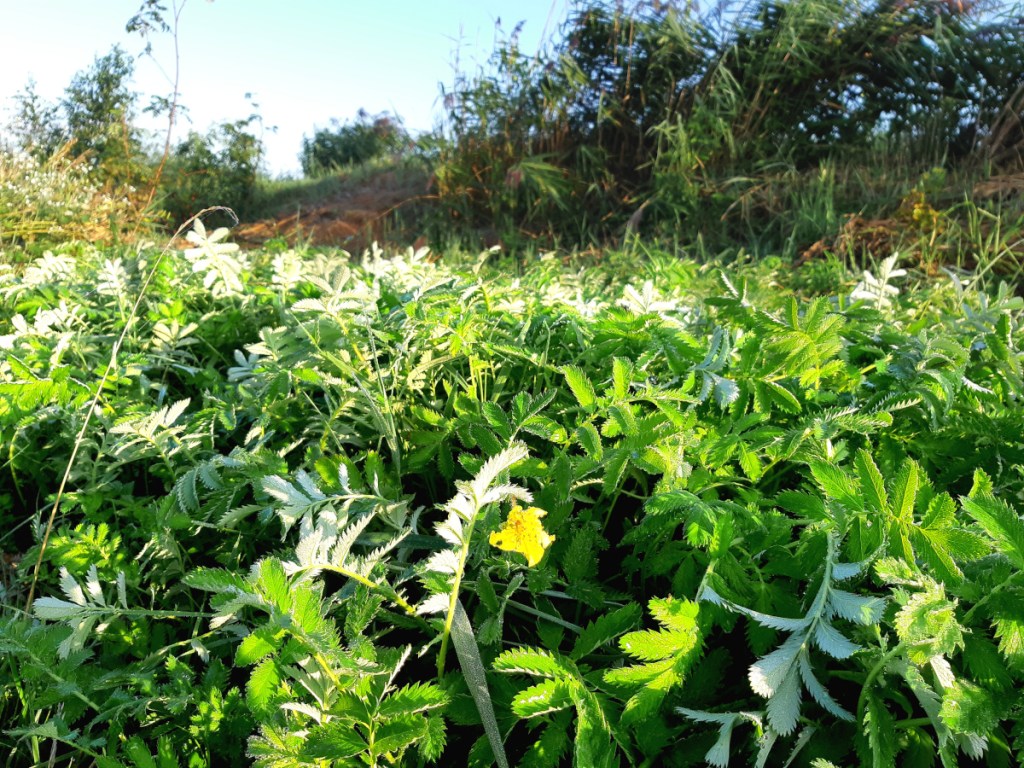
Op sommige plekken is het gras nu al helemaal verdwenen. Een tapijt van zilverschoon strekt zicht uit. In de lente zullen gele bloemen stralen als sterren. Het plantje hoort hier thuis, maar evengoed heb ik er hard aan gewerkt dat het er kwam. Heb gegraasd als een geit. Elke dag opnieuw. Gras uittrekken en steeds weer neerleggen, eromheen. Dikke pollen uitsteken, ruimte maken. Niet met hele vlaktes tegelijk, maar dan weer hier, dan weer daar. Als je het niet weet, dan zie je het niet, al dat werk. Zoals vaak. Je moet het horen.

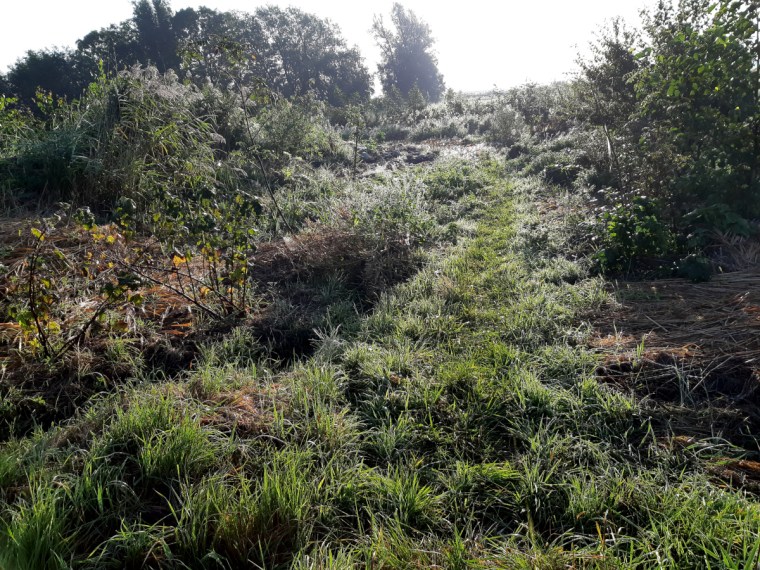
En nu sta ik hier, in de frisse vroege ochtend, aan het begin van het pad. Het is als een dompeling. Als je dit ziet, vergeet je alles. Achter de hoog opgegroeide haag bloeit van alles. Wit en lila raapzaad, roze wilgenroosjes, een concert aan bloemen zingt me tegemoet. Hier en daar zie ik een stipje geel van mosterdzaad en het paars van de twaalfjarige luzerne. Naarmate het jaar verstrijkt wordt het steeds uitbundiger. Een veldmuisje kruipt gauw weg onder een bosje geel veldlathyrus. In de verte schudt een haas de druppels van zijn vacht. De zeven torenvalken zie ik vandaag niet. Zelfs geen eentje. De blauwe kiekendief ook niet. Ik weet niet waar ze zijn. Ze komen wel weer terug. Eten zat.

Er groeit een palet aan verhalen. En er komen er nog veel meer.

Ik heb nu een paar keer iemand rond kunnen leiden. Gisteren vroeg iemand mij erom. Een vrouw, even oud als ik. Niet omdat ze bessen wilde eten of zo. Gewoon omdat ze het wilde zien, en mijn verhaal wilde horen. Dat is best bijzonder. De meeste mensen willen zelf iets, of verzinnen hun eigen verhaal. Ze lopen het liefst in hun eentje en laten hun fantasie gaan. Een enkeling neemt een vriendin mee om alles te laten zien. Ze komen als ik er niet ben. Dat kan natuurlijk ook. Ten slotte is het een verhalenpad. Hoe meer verhalen hoe beter. Ook zonder mij gaat het door. Maar toch wil ik ook zelf wel eens mijn verhaal vertellen. Mijn verhaal in het weelderige groen, dat groeide met eelt op mijn handen en zweet op de rug. Met beelden en woorden die net zo goed moeten groeien als de mispel en de lijsterbes. Hoe langer je wacht, hoe dieper het gaat. Maar als het er is, dan is het er. Al zie je het nog niet. Net als wortels in de grond. Het groeit. Eens komt het verhaal naar buiten. Als een barstende knop, vol levenslust na een droge lente. Dagen van gestage regen drenkt de gebarsten bodem tot hij zacht is. Het verhaal is taai, en wacht op het juiste moment. Net als de knop van een bloem. Of als zaad in de grond.

Zo is het. Nu. Hier, daar, overal.

.

De bloemen worden wakker
ze glinst’ren van de dauw
Ze knikken met hun kopjes
Kom hier, kom nu, kom gauw!
Zacht ritselt gindse lindeboom
en lispt als in een droom
Goedendag, goedendag mijn liefste,
Goedendag.

Lied, geïnspireerd door een oud Hollands wiegelied. Maar ik keerde het naar de ochtend.
In de luisterversie hoor je “werkfee” in plaats van “liefste”. Het laatste vond ik toch beter passen in de droom.

.

.

,

.

.

.

Zilverschoon

.

.

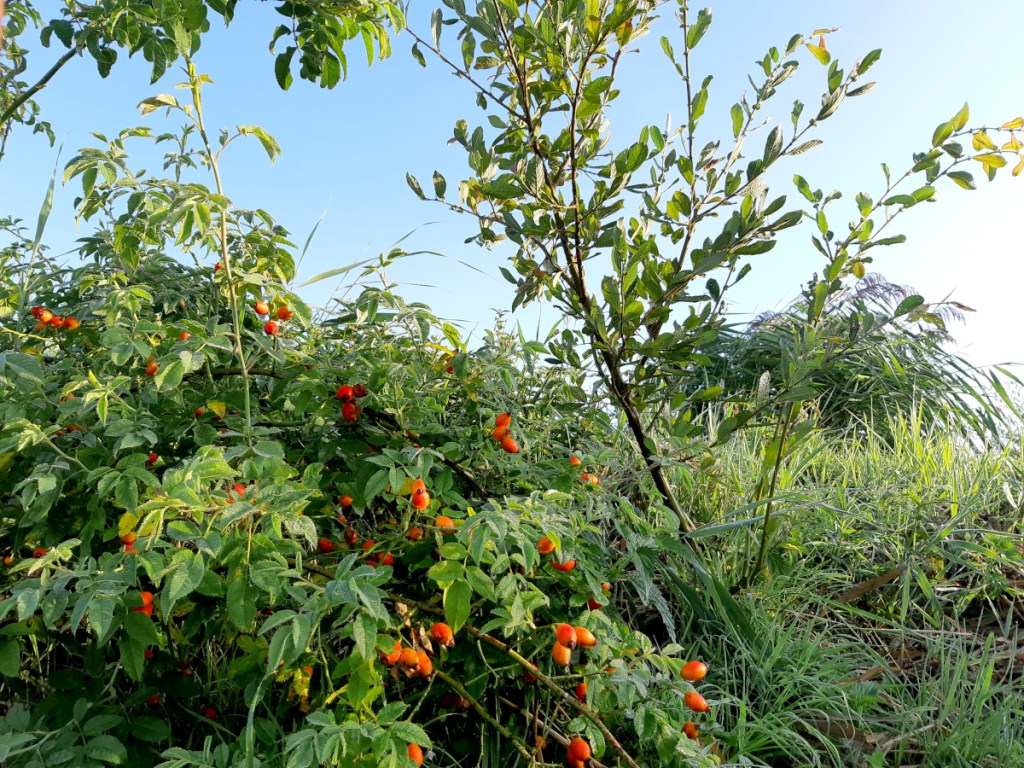
Rozenbottel

.

.


Ruwe berk (3,5 jaar oud, 2,5 jaar na aanplant)

.

.

.

.

The tough time of expactation

.

Days of steady rain soak the cracked soil until it is soft.

Something that grows slowly builds viability. It’s a tough time of anticipation, with cracked clay and leaves crackling with drought. But one day the rain falls and the bud bursts.

It’s the first thing I do when I wake up. I’m still in my pajamas and haven’t even done my exercises yet. The sunlight shines like silver over the dew, which lies like a glittering blanket of drops over the meadow. I walk through the grass, still dreamy with sleep. I roll up my pajama bottoms, otherwise they will get soaking wet. Around the corner at the ditch, across the meadow to that one place. The Paradise. The wild path I created with my own hands. The sun helped me. And the rain, the ditches, the bugs in the ground. And of course, the thirteen cubic meters of compost.

I stop at the entrance, next to the sign with the faded text. You can just read it, aging letters in creamy white. “Story Path”. Rarely has anyone asked about it. Except for those kids, in the beginning. They came to me: “Where are the stories?” I laughed. I showed them. Spiders in the grass. Lots of little spiders writing stories with lots of legs.

In some places the grass has already completely disappeared. A carpet of silver beauty stretches out. In spring, yellow flowers will shine like stars. The plant belongs here, but I also worked hard to get it there. Grazed like a goat. Every day again. Pull out grass and put it down again and again, around it. Stick out thick clumps, make room. Not with whole plains at once, but then here, then there. If you have no idea, you don’t see it, all that work. As often. You have to hear about it.

And now here I am, in the crisp early morning, at the beginning of the path. It’s like a immersion. When you see this, you forget everything. Everything blooms behind the high-grown hedge. White and lilac rapeseed, pink willowherbs, a concert of flowers sings to me. Here and there I see a speck of yellow from mustard seed and the purple from twelve-year-old alfalfa. As the year goes by, it gets more and more exuberant. A field mouse quickly crawls away under a bush of yellow field lathyrus. In the distance, a hare shakes the drops from its fur. I don’t see the seven kestrels today. Not even one. Not even the hen harrier. I don’t know where they are. They’ll be back. Sat eating.

A palette of stories is growing. And many more are coming.

I’ve been able to show someone around a few times now. Someone asked me about it yesterday. A woman, the same age as me. Not because she wanted to eat berries or anything. Just because she wanted to see it and hear my story. That’s pretty special. Most people want something for themselves, or make up their own story. They prefer to walk alone and let their imagination run wild. A few bring a friend to show them everything. They come when I’m not there. That is also possible, of course. Finally, it is a story trail. The more stories the better. It goes on without me. Now, and when I m dead. But I ‘m still living, and I also want to tell my own story. My story in the lush green that grew with calluses on my hands and sweat on the back. With images and words that should grow just as well as the medlar and the mountain ash. The longer you wait, the deeper it goes. But if it’s there, it’s there. Even if you don’t see it yet. Like roots in the ground. It grows. Once the story comes out. Like a bursting bud, full of zest for life after a dry spring. Days of steady rain soak the cracked soil until it is soft. The story is tough, waiting for the right time. Like the bud of a flower. Or as a seed in the ground.

That’s how it is. Now. Here, there, everywhere.

.

Song, inspired by an old Dutch lullaby.

The flowers wake up early
they glisten with dew
They nod their kind heads
Come now, the world is new!
Softly rustles yonder linden tree
and lisps special to me,
Lovely day, lovely day, my dearest, lovely day.

Brief aan de kunstenaars

Een verhalende sollicitatiebrief

.

.

Liever luisteren? Klik op de knop onderaan de tekst.

There is no english translation today.

.

.

Dag mensen,

Het is bijzonder, om weer terug te komen in Leeuwarden, na meer dan dertig jaar. Ooit studeerde ik hier op het Groot Schavernek, voor docent drama, en woonde bij de start van de Elfstedentocht. Die ik helaas nooit heb meegemaakt. Nu keer ik weer als breed georiënteerd kunstenaar, met een verhaal. Het is best lang, dat verhaal. Maar het laatste stukje ervan zal ik vertellen.

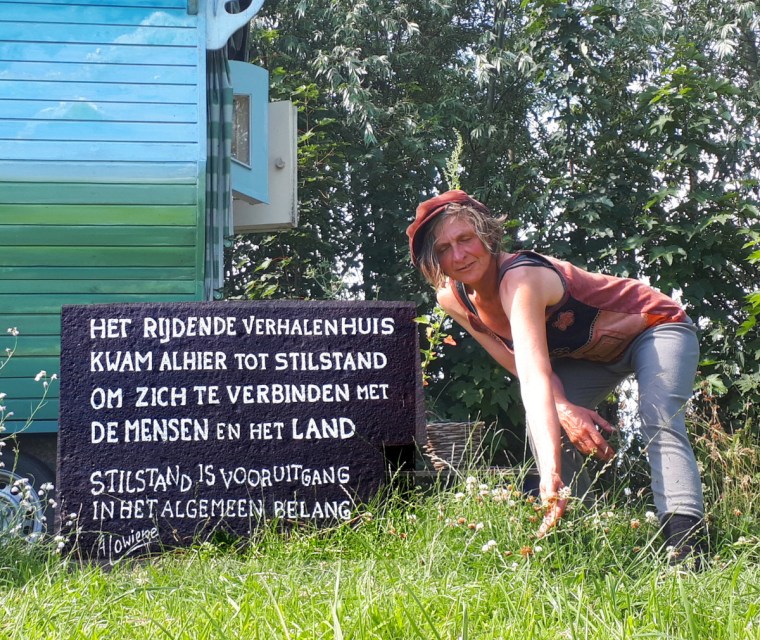
In 2020 kwam ik aan, met mijn Rijdende Verhalenhuis, in Bears op Ecocamping de Swetteblom. Boer Jochum heette me hartelijk welkom, met zijn woeste bos grijs haar. Ik had een reis gemaakt van drie maanden, door het Noorden van Friesland. Het boek dat ik schreef werd feestelijk gepresenteerd en kwam zelfs terecht in de bibliotheek. Een boek dat mijn band met de aarde verkent, vol ontmoetingen. Het boek waarin een ieder kan lezen wie ik ben en op welk pad het lot mij bracht. Het was een lange weg, met veel hobbels en kuilen. Maar het maakte me authentiek, inventief en zelfvoorzienend. Vaak was het zwaar, maar mijn nieuwsgierigheid doofde niet. Integendeel.

Ik woonde en werkte in Utrecht, aan de gracht. Was ook rondvaartschipper. Ik hield van de plek waar ik was, maar de geschiedenis ervan woog op mijn rug en doofde mijn creativiteit. Ik wilde verder. Dat deed ik. Ik begon een nieuw leven. Ontwierp en bouwde mijn Verhalenhuis, ging ermee op pad. Verhalen rijgen zich aaneen, niet alleen in het boek, maar op talloze manieren. Elke week maak ik een blog, elf jaar inmiddels al. Er staan tekeningen bij, en korte en lange films. Er zijn gedichten en podcasts. Een hele schatkist, inmiddels.

Nu woon ik al een tijdje op de Swetteblom. De belangrijkste bezigheid was het aanplanten van een Verhalenpad. Vierhonderd bomen en struiken bieden een thuishaven voor allerlei dieren. Ooit, in de toekomst, zullen mensenhanden er noten en appels kunnen rapen, in de herfst. Het begint al aardig groot te worden. Het duurt niet lang meer, dan kan het verder groeien zonder dat ik er steeds bij moet zijn.

Het bosje is een deel van het verhaal wat ik wil vertellen. Het verhaal, dat mensen en natuur niet gescheiden zijn, maar bij elkaar horen. Dat we hier hard aan moeten werken. Maar alleen het bosje is niet genoeg, om dat te vertellen. Er zijn zoveel bosjes… Het verhaal is méér dan dat. Het gaat over de aarde en alles wat er leeft. Om het door te geven, om het meer te laten zijn, moet ik erover vertellen. Niet alleen in woord, maar ook in beeld, in een ruimte waar ook andere mensen kunnen komen. Vele schetsen liggen klaar om uit te werken. Ik maakte ze als tekening, voor mijn blog. Soms wordt ernaar gevraagd. Verkoop je ze niet? Nee, zeg ik dan, ik wil er nog iets mee. Schilderen, verwerken, het is nog niet klaar. Maar dat kan nu niet. Het is praktisch onmogelijk. Het huisje van mij is heel erg klein. Ik heb een atelier nodig.

Ik vroeg Anne Graswinckel, met wie ik ooit samen op het Schavernek zat. Of ze iets wist. En Edith Stultiens. Zo kwam ik erachter dat dit atelier vrij kwam. Ik hoop dat het wat wordt. Niet alleen om aan het werk te kunnen, maar ook om andere kunstenaars te kunnen ontmoeten en samen dingen te kunnen organiseren. Ik hoop dat mijn verhaal aanspreekt, en dat ik in de toekomst meer van jullie zal horen.

Met hartelijke groet,

Alowieke van Beusekom

.

.

Het boek is nog steeds te bestellen, het liefst bij de uitgeverij zelf, daar hebben we het meeste aan: https://www.uitgeverijlouise.nl/boeken/boek?tx_usersales_bookshow%5Baction%5D=show&tx_usersales_bookshow%5Bbook%5D=82&tx_usersales_bookshow%5Bcontroller%5D=Book&cHash=eb1af16aa2b7818717898385c8f62880

.

Weg van de gewenning. . . (A Way form the habbit)

Alles begint en eindigt bij het parkeren van je auto.

.

Niet parkeren.

.

Liever luisteren? Klik op de knop onderaan de tekst.

Do you like to read the ENGLISH translation? Click on the button underneath.

Vanuit mijn huis kan ik het net zien, tussen alle begroeiing door. Het veld, de sloot, met de rietkraag eromheen, en het weiland erachter. Het weiland in de zomer is anders dan in de winter. In de winter is alles verlaten. Het enige wat je hoort is het gekwetter van spreeuwen en het staccato geroep van de kramsvogels wanneer ze je zien. Het geluid van hun vleugels, wanneer ze massaal opvliegen. In de zomer zijn de kramsvogels weg. Andere vogels trekken zich terug op andere weiden, die helaas niet biologisch zijn en lang niet zo onberoerd als de onze. Voor onze boer is de wei om te hooien en wilde bloemen te laten groeien. Voor de weekendgasten, op weg naar hun feestje, is het vooral een lege ruimte. Wat doe je daarmee? Natuurlijk, een balletje trappen. Maar in de eerste plaats: je auto neerzetten. Of je nou links stemt of rechts, Groenlinks of BBB, bijna iedereen doet het. Gewoontes zijn hardnekkig. Ik denk: Als we het in deze oververhitte wereld anders willen, zullen we ergens moeten beginnen. Verandering van gewoontes.

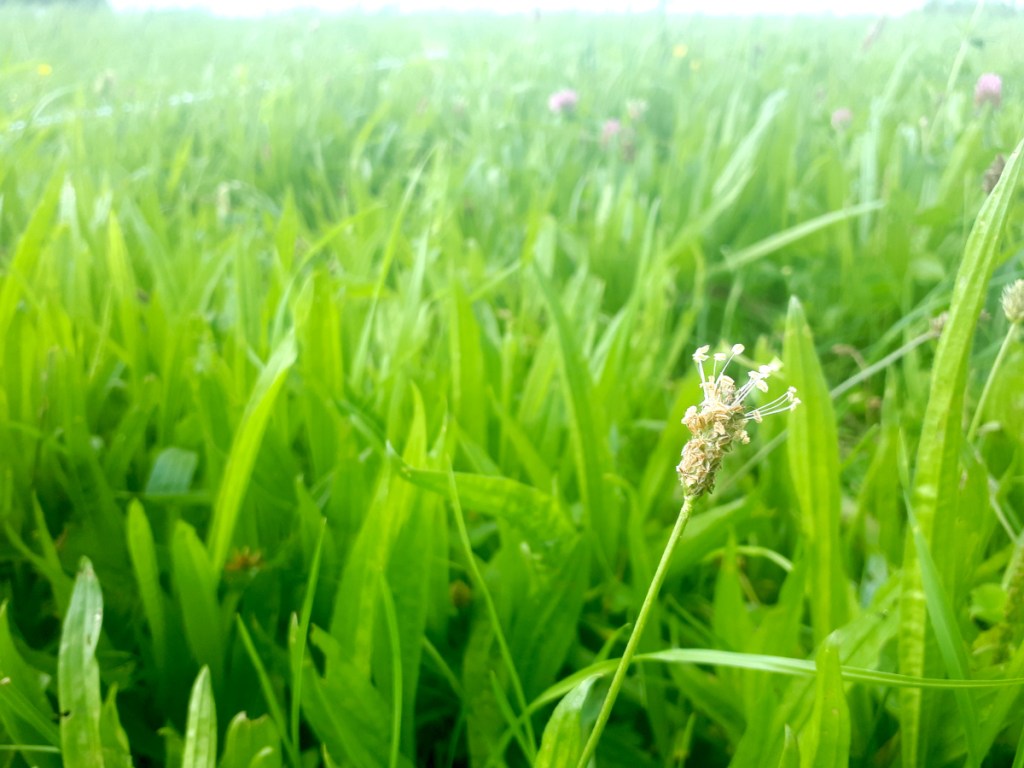
Wanneer ik net mijn huis op orde heb, komt de eerste auto aanrijden. Hij parkeert achter de sloot met een snelle draai in. Het is het laagste stuk. Als het winter was, had hij nu vastgezeten. Het heeft nu ook veel geregend, maar zompig is het nog niet. Ik kijk er goed naar en realiseer me iets. Op die plek groeit mijn thee! Smalle weegbree is het, voor de luchtwegen. Het staat op een bijzonder plekje. Nadat een dampendhete berg bladcompost de hele grasmat had verschroeid, was het enige wat overleefde dit zaad. Het zaad van de weegbree. Nu het staat daar, in een mooie cirkel, dicht op elkaar, zonder ook maar één grassprietje ertussen. Ik ben er blij mee. Ik loop erheen en zie inderdaad een spoor, dwars erdoorheen. De automobilist had er zeker zin in, dat feestje. Hij is met een vaartje doorgeschoten in zijn achteruit, een heel eind het weiland op.

Ik loop naar de kampeerders. Er zijn er al een paar bezig hun tent op te zetten. Hun jonge stemmen klinken vrolijk en opgewekt. Er staat zachtjes een muziekje aan, rustige lichtvoetige jazz is het. “Hoi!” roep ik “Er is iemand door mijn thee gereden.” Ik kijk verkennend rond. De jongen die het laatst aankwam komt meteen naar me toe. Hij loopt met me mee en geïnteresseerd ziet hij wat hij eerst niet zag. “Goh,” zegt hij “Ja zeg! Ik denk dat de anderen dit ook niet zien. Ik zal het omheinen, met een touw.” Hij gaat meteen aan de slag. Ondertussen stelt hij allerlei vragen, hoezo die kruiden op deze plek, en helpt het inderdaad zo goed voor de luchtwegen. Met plezier geef ik antwoord. Maar zijn auto staat nog steeds midden in de wei. Ik wijs hem op een hoger stuk, vlak langs de weg. “Daar is beter. Daar parkeren vaker auto’s” zeg ik “Als je hem midden op het veld laat staan, dan zetten de anderen hun auto’s er straks naast. Dan ben jij het voorbeeld. Beter van niet.” Hij snapt het meteen en zet zijn auto neer op de gewezen plek.

Het leven bestaat uit talloze gewoontes. Met elkaar maken we ons bestaan op aarde, zoals het is. Inmiddels erkent iedereen dat het anders moet. Dat we de natuur meer plek moeten geven, gewoon, waar we wonen. Steeds meer mensen begrijpen hoe belangrijk een losse humusrijke bodem is, als basis voor al het leven. De meeste snappen het wel, maar hoe pas je dat toe? Je doet wat je doet en de agenda zit vol. Je schiet van het één naar het andere, en schiet gauw door. Dat is vergeeflijk, maar daar begint het wel mee. De verandering.

Later die dag kom ik er weer terug. Ik knip de platgereden blaadjes af om te drogen. Vertederd kijk ik naar het witte touw, dat mijn thee omheint. En naar de drie geparkeerde auto’s, op het hoge stuk, vlak langs de weg. Die jonge lui zijn toch niet gek! Opnieuw denk ik, wie weet kan het. Wie weet komt het toch, uiteindelijk, allemaal goed.

.

.

A Way from the habbit

From my house I can just see it, through all the vegetation in front of the window. The field, the ditch, with the reed around it, and the meadow behind it. The pasture in the summer is different than in the winter. In winter everything is deserted. All you hear is the twitter of starlings and the staccato calls of the fieldfares when they see you. The sound of their wings, when they take flight. In the summer the fieldfares are gone. Other birds retreat to other pastures, which unfortunately are not organic and not nearly as untouched as ours. For our farmer, the meadow is for making hay and growing wild flowers. For the weekend guests, on their way to their party, it is mainly an empty space. What do you do with that? Of course, kick a ball. But first of all: park your car. Whether you vote left or right, Groenlinks or BBB, almost everyone does. Habits are persistent. I think: If we want to change things in this overheated world, we have to start somewhere. Change of habits. Everything starts and ends with parking your car.

When I’ve just got my house in order, the first car drives up. He parks behind the ditch with a quick turn. It’s the lowest part. If it were winter, he would be stuck by now. It has also rained a lot now, but it is not soggy yet. I look closely and realize something. That’s where my tea grows! Narrow plantain it is, for the respiratory health. It is in a special place. After a steaming hot mound of leaf compost scorched the entire turf, the only thing that survived was this seed. The seed of the plantain. Now it’s there, in a nice circle, close together, without a single blade of grass in between. I’m happy with it. I walk towards it and indeed see a track, right through it. The motorist was certainly looking forward to that party. He sped along in reverse, a long way out into the pasture.

I walk to the campers. Some of them are already setting up their tents. Their young voices sound cheerful. There is soft music playing, quiet light-footed jazz it is. “Hi!” I shout “Someone drove through my tea.” I look around. The boy who arrived last comes straight to me. He walks with me and with interest he sees what he didn’t see before. “Gosh,” he says “Yes! I don’t think the others see this either. I will fence it in with a rope.” He immediately gets to work. In the meantime he asks all kinds of questions, why those herbs in this place, and does it indeed help so well for the airways. I will answer with pleasure. But his car is still in the middle of the meadow. I point him to a higher area, close to the road. “There is better. Cars park there more often” I say “If you leave it in the middle of the field, the others will park their cars next to it. Then you are the example. Better not.” He immediately understands and parks his car at the designated spot.

Life consists of countless habits. Together we make our existence on earth, as it is. Everyone now recognizes that things have to be done differently. That we should give nature more space, just where we live. More and more people understand how important a loose, humus-rich soil is, as the basis for all life. Most get it, but how do you apply it? You do what you do and the agenda is full. You shoot from one thing to the next, and quickly shoot through. That’s forgivable, but that’s where it starts. The change.

I’ll be back later that day. I cut off the flattened leaves to dry. Endeared, I look at the white rope that surrounds my tea. And to the three parked cars, on the high part, close to the road. Those young people aren’t crazy! Again I think, who knows. Who knows, maybe it will all work out in the end.

Er is toekomst . . . (There is future)

Een verhaal over de tegenstelling tussen efficienty en verwondering, of ontzag.

.

.

Liever luisteren? Klik op de knop onderaan de tekst.

You can find the ENGLISH translation underneath.

“Als ik dan elke dag riet aan het snijden ben. . .” begin ik te vertellen. . . Naast me, op de lange bult, staat een bezoeker. Hij kwam vooral omdat hij hier bessen had gezien. Of hij die mocht plukken. Dat vond ik prima, maar dan wel met een verhaal erbij. Tenslotte is dit geen Eetpad, maar allereerst een Verhalenpad. “dan voel ik me zo klein in dit landschap” vervolg ik mijn verhaal. “Alles zou riet zijn, zonder ons. Eindeloos, tot de horizon. Sta ik daar met mijn sikkel.” Maar de man is niet gevoelig voor poëzie. “Ja.” Hij glimlacht geruststellend. “Maar dat hoeft niet meer. Daarvoor hebben we machines.” Ik schud mijn hoofd. “Dat is niet wat ik bedoel. Als je met de hand werkt, met je voeten op de klei, dan voel je je veel meer verbonden met het land.” Zijn mond hangt een beetje open. “O..” zegt hij. We lopen een stukje verder, want hij ziet een bessenstruik. Gretig begint hij te plukken. “We moeten meer bessen eten,” zegt hij kauwend. Ik kijk het een poosje aan. “Laat je nog wat over?” vraag ik dan droogjes. Hij schrikt op. “O ja”. Dan vertel ik verder over het werk. “Ik hak vooral riet met de sikkel. Dat is wel doorwerken, al die meters.” Hij kijkt me vaderlijk aan. “Je kan ook een bosmaaier gebruiken,” licht hij me voor. Maar ik ben zeer beslist in mijn antwoord. “O nee. Geen bosmaaier hier. Een bosmaaier maakt blind en doof. Op een Verhalenpad leer je juist verhalen zien. En te horen. Ik kijk liever naar een broedende vogel in plaats van per ongeluk zijn nest stuk te raggen.” Hij kijkt schuldbewust. Alsof hij het persoonlijk was, die dat deed. Alsof hij het eigenlijk niet goed mag keuren, dat door mechanisatie zoveel over het hoofd wordt gezien. Maar ja. Het moet wel. Denkt hij.

De volgende dag sta ik daar weer. Maar dan alleen. Het is nog vroeg, half acht in de ochtend. De zon is nog niet achter de sluierwolken vandaan gekomen. Ik houd van die koelte. Straks zal het vast weer broeierig worden. In mijn hand heb ik dit keer de heggenschaar. Daarmee kan ik preciezer werken. Op mijn hurken waggel ik door het gras om beginnende rietstengeltjes kort en klein te maken. Het gaat toch verrassend snel. Ik kom bij een hoger bosje, dat ik rond een stokroos gelaten heb. De lange stengels zijn omgewaaid door de storm, maar hij bloeit gewoon door, op de grond. Mooie grote bloemen, vol hommels, een zoemend bloemenbosje is het. Steeds dichter kom ik bij de stengels. Het geluid van de heggenschaar is het enige wat ik hoor. Het is windstil en zelfs de karekiet in het riet houdt zijn snavel. Tik tik, doet de schaar. Maar dan ineens krioelt het, daar waar eerst beschutting was van gras en klein riet, vlak achter de bloemen. Nu is het er kaal. Mieren lopen kris kras door elkaar, en beginnen eieren naar buiten te brengen. Een bruinoranje nachtvlinder hipt ongelukkig rond. Hij springt op mijn toegestoken vinger. Ik heb zijn linker vleugel afgeknipt. Stom. Ik wist het immers best, dit bosje moest ik zo laten. Ik ben te ver gegaan.

Ik probeer dit steeds te voorkomen. Al werkend blijf ik kijken. Ik ziet de hommel, die uit zijn hol komt en trek me respectvol terug. Er is immers genoeg werk. Dus ik ga verder bij de hazelaars, brandnetels uittrekken, gele wortels met kluiten eraan. Ik schud ze uit en gooi ze op een hoop. De brandnetels voor me bloeien nog niet. Ze zijn fris en groen, de blaadjes. Dan zie ik opnieuw die kleine zwarte bolletjes op het blad. Het zouden korrels aarde kunnen zijn, die ik daar rondgestrooid heb. Maar ze zijn perfect rond van vorm en liggen op gelijke afstand van elkaar. Dat trekt mijn aandacht. Even verderop zie ik een kleine zwart met grijs gestreepte rups. Ah, het zijn dus toch eitjes! Opnieuw stop ik. Ik heb immers al een heel stuk gedaan, de rest mag blijven voorde vlinders . Ik loop terug. Het is tijd voor pauze. Bij de entree staat een bos verdwaalde oeverplanten, die zich als lange tongen achter de haag verzamelen, in de vochtige greppel. Ik weet dat daar in die buurt een kleine hommel woont, onder het pellet dat daar ergens ligt te rotten. Ik laat het. Al betekent het meer werk, om het steeds weer te begrenzen. Op een dag zal dat steeds minder worden. Op een dag.

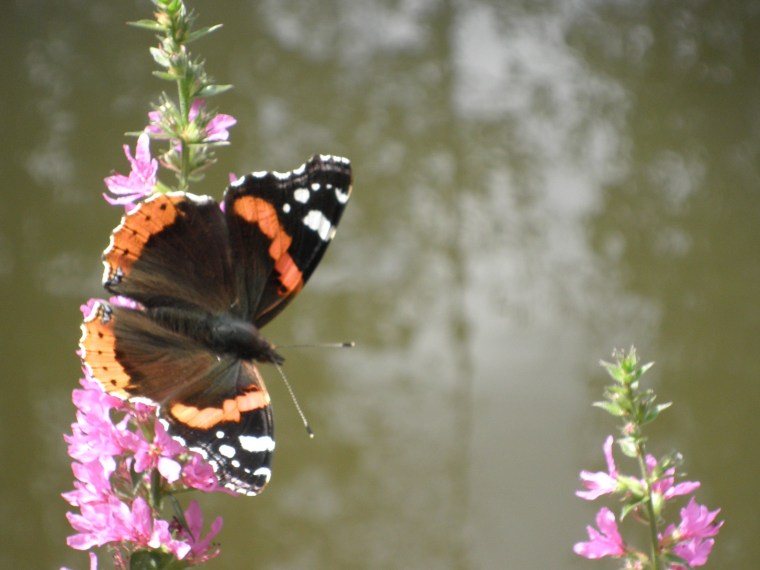
Even later zit ik tevreden in mijn kas koffie te drinken. Voor de deur loopt een stel meiden langs, het zijn dertigers. Hun tentjes staan hier op het veld en ze zijn op weg naar mijn buurvrouw. Glimlachend kijken ze bij mij naar binnen. Ik weet, het ziet er knus uit. Ik roep naar ze: “Denken jullie aan de vlinder??” Want natuurlijk, ik heb het ze verteld. Elke dag om dezelfde tijd zit er een Atalanta te zonnen op het zandpaadje. “Ja!” roept de een, “We lopen er steeds met een grote boog omheen!” Mijn glimlach verbreed zich tot een grijns. Glanzend kijk ik ze na. Er is toekomst.

.

.

THERE IS FUTURE.

A story about the contradiction between efficiency and wonder, or awe.

.

“When I am cutting reeds every day. . .” I start my story. Next to me, on the long hump, is a visitor. He came mainly because he had seen berries here. If he could pick it. I thought that was fine, but with a story to go with it. After all, this is not a Food Path, but first and foremost a Story Path. “I feel so small in this landscape” I continue. “Everything would be reeds without us. Endless, to the horizon. And I stand here with my sickle.” But the man is not sensitive to poetry. “Yes.” He smiles reassuringly. “But that is no longer necessary. We have machines for that.” I shake my head. “That’s not what I mean. When you work by hand, with your feet on the clay, you feel much more connected to the land.” His mouth hangs open a little. “Oh…” he says. We walk a little further, because he sees a berry bush. He eagerly begins to pick. “We need to eat more berries,” he says, chewing. I watch it for a while. “Do you leave some left?” I ask dryly. He startles. “Oh yeah”. Then I tell him more about the work. “I mainly chop reeds with the sickle. That means continuing to work, all those meters.” He looks at me paternally. “You can also use a brushcutter,” he explains. But I am very firm in my answer. “Oh no. No brushcutter here. A brushcutter makes blind and deaf. On a Story Path you learn to see stories. And to hear. I’d rather watch a nesting bird than accidentally destroy its nest.” He looks guilty. As if it was him personally who did that. As if he shouldn’t actually approve of the fact that so much is overlooked due to mechanization. But yeah. It has to, he thinks.

The next day I am there again. But then alone. It is still early, half past eight in the morning. The sun has not yet come out from behind the veil clouds. I like that coolness. Soon it will be sweltering again. In my hand I have the hedge trimmer this time. This allows me to work more precisely. On my haunches, I waddle through the grass to cut budding reed stems short and small. It goes surprisingly fast. I come to a higher bush, which I left around a hollyhock. The long stems have been blown over by the storm, but it continues to bloom on the ground. Beautiful large flowers, full of bumblebees, it is a humming bunch of flowers. I get closer and closer to the stems. The sound of the hedge trimmer is all I hear. There is no wind and even the reed warbler keeps its beak in the reeds. Tap tap, do the scissors. But then suddenly it is teeming there, where there used to be shelter of grass and small reeds, just behind the flowers. Now it is bare. Ants criss-cross each other, and begin to bring out eggs. A brown-orange moth hops around unhappily. He jumps on my stabbed finger. I cut off his left wing. Stupid. After all, I knew best, I had to leave this bush as it was. I’ve gone too far.

I always try to avoid this. I keep watching while working. I see the bumblebee coming out of its hole and respectfully withdraw. After all, there is enough work. So I move on to the hazels, pull up nettles, yellow roots with clods on them. I shake them out and toss them in a pile. The nettles in front of me haven’t bloomed yet. They are fresh and green, the leaves. Then I see those little black dots on the leaf again. It could be grains of earth that I scattered there. But they are perfectly round in shape and are equidistant from each other. That catches my attention. A little further on I see a small black and gray striped caterpillar. Ah, so they are eggs! Again I stop. After all, I’ve already done a lot, the rest can stay for the butterflies. I walk back. It’s time for a break. At the entrance there is a bunch of stray shore plants, which gather like long tongues behind the hedge, in the low moist ground. I know there’s a little bumblebee living in that neighborhood, under the pellet that’s rotting there somewhere. I leave it. Although it means more work to limit it again and again. One day it will become less and less. One day…

A little later I am satisfied in my greenhouse drinking coffee. A group of girls walk by in front of the door, they are in their thirties. Their tents are here on the field and they are on their way to my neighbor. They smile at me. I know, it looks cozy. I call out to them: “Do you remember the butterfly??” Of course, I told them. Every day at the same time there is an Atalanta sunbathing on the sandy path. “Yes!” shouts one, “We always walk around it!” My smile widened into a grin. I stare at them gleefully. There is future.

Labyrint . . . labyrinth

.

.

Liever luisteren? Klik op de knop onderaan de tekst.

You can find the ENGLISH translation underneath

.

Vandaag ga ik naar de Vlierhof, waar mijn vriend Dick de hele zomer woont. Dat is een levendige plek. Ze hebben me graag, met mijn groene vingers en verhalen. Vooral de tuinvrouwen. Die komen handen en vooral ogen te kort. Ik heb er twee leren kennen. De een voor het grote werk, de ander richt zich op één speciale plek: Het labyrint. Ze nam het werk over van haar voorgangster. Ik herken iets in de concentratie waarmee zij bezig is. En deze dag wil zij het delen. Dus het is daar, waar wij elkander treffen. Karlijn, zes anderen en ik.

Een labyrint is geen doolhof. Het is een oude geometrische vorm, die bedoeld is om aandachtig of meditatief te bewandelen. Voor sommigen gaat dat diep, anderen wandelen met een opgeruimde glimlach. Weer anderen lopen tegen hun ongeduld aan, en willen er eigenlijk meteen alweer uit. Of je komt het allemaal tegen, één voor één.
Ik maak mijn ronde om het labyrint. Ik stap over de bakstenen heen, die als platte kantelen de cirkel omringen. Als stralen rond de maan. Net als ik weer bij de ingang kom, kraait een haan. En als er een haan kraait, dan ga ik naar binnen.
Daar loop ik dan. Dankzij de haan. Het labyrint is als het leven zelf. Ja, dat merk ik wel. Door de haan ben ik erin gekukeld. Het leven in, als een lang parcours, niet van te voren te overzien, als je ervoor staat. Net als 58 jaar geleden. Het eerste kwart van het labyrint leidt door je jeugd. Ja, dat klopt wel. Jeugd, ongeduld, impulsiviteit. Meteen wil ik akkerwindes tussen de hagen uitrukken. Die staan nog steeds overal. Vaak klein nog. Klaar om meters te maken. Maar ik kom er niet aan. Doorlopen nu. Kijken waar ik loop. “Eén twee in de maat, anders wordt de juffrouw kwaad.” Ja. Ik weet het nog. De paadjes zijn smal en strak omlijnd. Je moet goed opletten, net als vroeger op school. Ik hoor een dikke hommel, die in een noodvaart dwars over het parcours heen vliegt. Hij wel! En ik moet dat hele eind nog. Stap voor stap. Even later zie ik iets springen. Het is een vlieg met één vleugeltje. Ja, bedenk ik me. In het leven moeten we ook aandacht hebben voor de slachtoffers. Ik kniel naast hem tot hij weer op zijn gemak tussen de blaadjes kruipt, op een warm plekje in de zon. Nog steeds zie ik de akkerwinde, de razendsnelle bedekker, die alle planten omlaag trekt. Ik beheers me.
Al lopende kom ik tot rust. Het maakt me niet meer uit hoe lang het duurt. Ik zet de ene stap na de andere. Af en toe kom ik iemand tegen, net zo ingekeerd als ik. Er is weinig plek en we wentelen vlak langs elkaar heen, zonder elkaar te raken.
En terwijl ik voortga, kijk ik opnieuw naar de winde, zonder hem uit te willen trekken. En nu zie ik het wonderlijke ervan. Er zit een vast ritme in. Hij wikkelt zich twee keer om een stengel en maakt dan een bloem. Elke keer weer. Een witte kelk als een pispotje. Dat ritme! Wat een levenskracht spreekt daaruit. En dan de bloem, die je af kan plukken maar die niet verwelkt. Die gaat gewoon door met zaad maken. Is dat niet wat ik als mens ook nodig heb? Ritme, vitaliteit?
Dan kom ik langs de volgende plant. Het zijn grote saliestruiken. Ze zijn pas gesnoeid, anders kom je er niet langs. Er liggen nog wat losse takjes op de grond. Ik ga met mijn hand langs de struiken en ruik aan mijn hand. Het is een en al salie, met zijn opgeruimde en rustgevende geur. Ik raap de takjes op en maak er een bosje van. Als winde mij levenskracht geeft, dan heb ik ook flink wat salie nodig. Salie, om het parcours rustig af te kunnen maken zonder meteen al het andere te overheersen.

Met het bosje in de hand nader ik de uitgang. Vlak ervoor sta ik even stil. Als het labyrint het leven is, dan is de uitgang het einde ervan. Ik hoop dat ik net zo levenskrachtig eindig en toch vol rust. En dat onze energie, van alle mensen samen nog vele wonderen zullen verrichten.
Zo’n labyrint is een voorbeeld, van hoe een klein stukje grond veel kan bevatten. Ik kan als een hommel over de continenten scheren. Ik kan me ook beheersen, en al mijn aandacht op deze plek richten. Zo wordt een plek heilig. Zo, en niet anders.


Alle mensen komen een voor een naar buiten, de cirkel uit. We komen bij elkaar en vertellen onze verhalen. Lang of kort, met of zonder woorden. Ik drink mijn thee en kijk naar de gezichten. Hier kwam ik voor.

.

.

.

Today I’m going to the Vlierhof, where my friend Dick lives all summer. That’s a lively place. They like me, with my green fingers and stories. Especially the gardeners. They are short of hands and especially eyes. I got to know two of them. One for the big work, the other focuses on one special place: The labyrinth. She took it over from her predecessor. I recognize something in the concentration with which she is engaged. And this day she wants to share it. So that’s where we meet. Karlijn, six others and me.

A labyrinth is not a maze. It is an ancient geometric shape, which is intended to be walked attentively or meditatively. For some that goes deep, others walk with a cheerful smile. Still others run into their impatience, and actually want to get out immediately. Or you come across it all, one by one. I make my rounds around the labyrinth. I step over the bricks that surround the circle like flat battlements. Like rays around the moon. Just as I get back to the entrance, a rooster crows. And when a cock crows, I go in. There I walk. Thanks to the cock. The labyrinth is like life itself. Yes, I do notice that. The cock knocked me into it. Life in, like a long course, impossible to oversee in advance, when you stand for it. Just like 58 years ago. The first quarter of the labyrinth leads through your childhood. Yes, that’s right. Youth, impatience, impulsiveness. Immediately I want to tear out bindweeds between the hedges. They are still everywhere. Often small. Ready to measure. But I restrain myself. Continue now. Watch where I walk. “One two, one two, one foot for the other.”
The paths are narrow and well-defined. You have to pay attention, just like you used to in school. I hear a fat bumblebee flying across the course at breakneck speed. He does! And I still have to go all the way. Step-by-step. A moment later I see something jumping. It is a fly with one wing. Yes, I realize. In life we must also pay attention to the victims. I kneel next to him until he settles comfortably between the leaves again, in a warm spot in the sun. I can still see the bindweed, the lightning-fast cover plant, which pulls all the plants down. I control myself. As I walk, I relax. I don’t care how long it takes anymore. I take one step after another. Every now and then I come across someone just as introverted as I am. There is little space and we roll close to each other, without touching. And as I go on, I look again at the bindweed, not wanting to pull it off. And now I see the wonder of it. It has a fixed rhythm. It wraps itself around a stem twice and then makes a flower. Every time again. A white chalice like a piss pot. That rhythm! What a life force emanates from that. And then the flower, which you can pluck but which does not wither. It just continues to make seed. Isn’t that what I need as a human being? Rhythm, vitality? Then I pass the next plant. They are large sage bushes. They have just been pruned, otherwise you will not pass them. There are still some loose twigs on the floor. I run my hand along the bushes and smell my hand. It is all sage, with its clean and soothing scent. I pick up the twigs from the ground and make a bunch of them. If bindweed gives me life force, then I also need quite a bit of sage. Sage, to be able to finish the course quietly without immediately dominating everything else. With the bush in hand I approach the exit. Just before that, I stopped for a moment. If the labyrinth is life, then the exit is the end of it. I hope I end up just as vibrant and still full of peace. And that our energy, of all people together, will still work many miracles. This labyrinth is an example of how a small piece of ground can contain a lot. I can skim over the continents like a bumblebee. I can restrain myself too, and focus all my attention on this place. This is how a place becomes sacred. It ’s the only way.

All people come out the cirkle one by one, . We come together and tell our stories. Long or short, with or without words. I drink my tea and look at the faces. This is what I came for.

Hou vol! …. Hold on!

Leven naar de wet van wederkerigheid.

Living by the law of reciprocity.

.

.

Liever luisteren? Klik op de knop onderaan de tekst.

“Wat een mooi huis heb je” zeg ik. Ik ben even binnen bij een vriendin. Het is een groot huis, althans, voor mij dan. Voor andere mensen is het gewoon een redelijk kleine stacaravan. Maar toch, er is een slaapkamer, een keuken en een werkhoek. Bovendien een fijne zithoek en een plee. Er is een ingang waar je zonder moeilijk te doen in kan. Als ik even later thuiskom, ben ik het even zat, dat kleine kamertje, waar je alleen kan schrijven, slapen, dromen en naar buiten kijken. Geen plek om schilderijen te maken. Zeker niet met olieverf, dat duurt wel drie dagen, voor het droog is. In zo’n klein huisje zit alles eronder, als dat zo lang duurt. Deze winter kocht ik drie hele mooie tubes. Precies de goeie kleuren om alle tinten te kunnen mengen. Maar ja. Waar??

Wat doe ik dan wel, behalve schilderen? Ik ben altijd buiten aan het werk. Er is dan ook enorm veel gebeurd, dit jaar. Er is een verscheidenheid aan planten gaan groeien, op diverse plekken. Het begin van het Verhalenpad is echt mooi aan het worden. Tussen de opgroeiende bomen bloeit pastinaak, lila raapzaad, en twaalfjarige luzerne. Vijf aardappels zijn uitgegroeid tot planten van wel een meter doorsnee. Nooit heb ik zulke mooie bloemen gezien, aan aardappels. Paars met wit zijn ze. Ik kijk mijn ogen uit. Werk aan de bodem loont. En er zijn meer parels bij het pad gekomen. Er is nu ook wilde appel en wilde mispel. Ik verzorg een aantal kleinblijvende walnootbomen, die op de bult staan. Ik plantte een James Grieve en een Cox, appels die ik erg lekker vind. En nog veel meer.
Maar ook mijn woonerf is veranderd, met de nieuwe kas. De zwarte constructie valt mooi weg tegen het groen. Er is een dikke stenen vloer, die houdt de warmte vast. Op regenachtige dagen is het er nog steeds goed toeven. Ik zit er soms te lezen en met een bakkie koffie. Het harde werk is niet voor niks geweest.

En toch ben ik het soms opeens zat. Had ik maar een echt huis, denk ik dan. Niet voor al die planten en beestjes, maar helemaal voor mijzelf. Dat ik breeduit en met grote passen naar mijn voordeur kan lopen, in plaats van voorzichtig tussen de jonge walnootbomen te moeten kruipen die daar opgroeien in een pot. We delen met zijn allen het kleine lapje grond, waar beschutting is. De bomen en de vogels en wat al niet meer. Voor hen kruip ik elke dag mijn huis in, heel stilletjes. Omdat ik mijn ruimte klein houdt en wil delen. We hebben allemaal beschutting nodig. Niet alleen ik. Maar soms ben ik dat zat, dat gekruip, dat gemier naar de voordeur en een kleine kamer. Had ik maar een echt huis, met een echte deur en allerlei kamers. Een riant atelier waar mijn doek kan hangen. Waar ik een aanloop kan nemen met mijn kwast. Net als Karel Appel.

Het is een bui. Een onweersbui, die komt en gaat. Soms knettert het, heel even maar. Dan is het goed om eens een paar dagen uit te rusten.
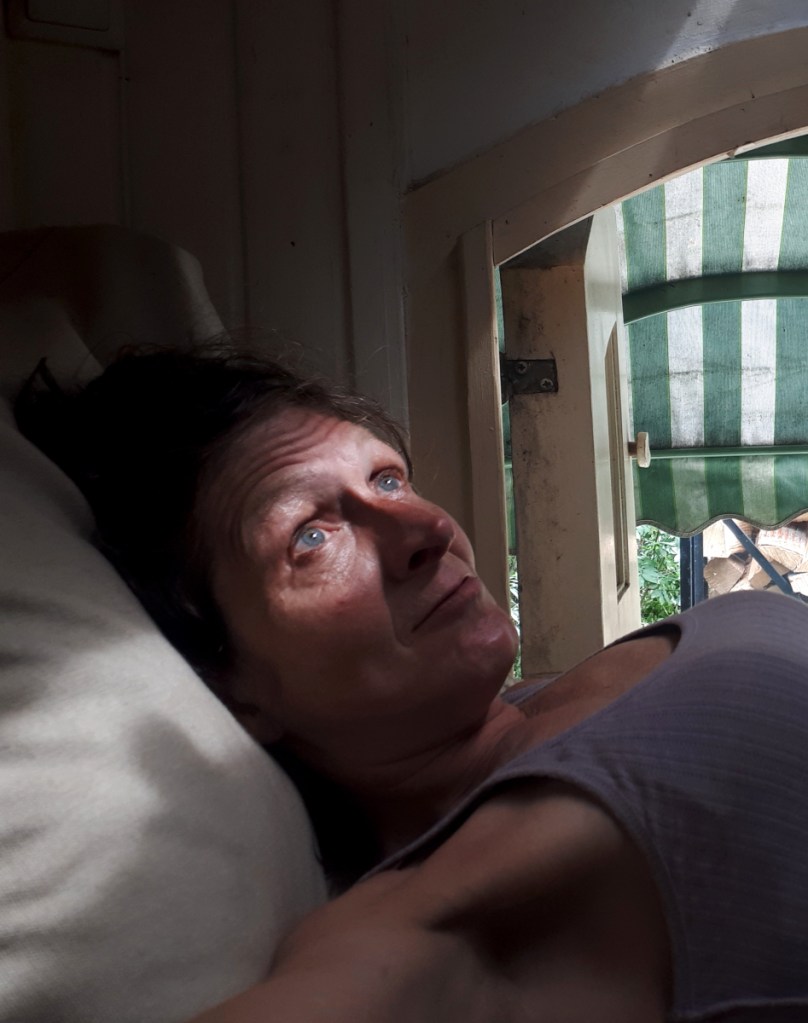
Zo gezegd zo gedaan. Op een warme dag zit ik stil in mijn koele hol. De luiken zijn gesloten. Toch is het niet donker. Het daklicht en de geopende achter en voordeuren zorgen voor licht in huis. Er waait een verkoelend briesje om mij heen. Ik zit hier goed. Ik kijk naar boven. Er zit nog iets voor het dakraam. Het donkere doek, waarmee ik ’s nachts mijn kot verduister. Een klein stukje hangt er nog voor en houdt het licht tegen. Ik trek eraan. Het doek valt en er komt een hele wolk nachtvlindertjes uit. Gauw stop ik het weer terug. Dat krijg je, als je met de bovendeuren open slaapt. Boven de geopende deurtjes hangt het markies met brede groene strepen. Ik kan er net onderdoor kijken. Ik kijk naar de kas, vlakbij me. Ik zie de bloemenpracht erachter. Allemaal dit jaar uit de grond gekomen. Wat een wonder eigenlijk. Dromerig kijk ik naar de rode papavers, die boven de kleinere bloemen uitsteken. Achter de wagen klinkt het gekwetter van mussen en jonge mezen. Terwijl daarnaar luister, komt er opeens iets aanvliegen. Zomaar onder het markies door. Het landt op mijn voet. Het is een jonge koolmees, zijn zwarte kap is nog wat grijs. Verbaasd kijk ik naar het jonge ding. Hij ziet mij niet, alleen mijn sok. Hij bestudeert hem zorgvuldig. Ik heb vanochtend kleefkruid gewied en er kleven nog steeds een paar zaadbolletjes aan. Doodstil kijk ik wat er gebeurt. Hij pikt vakkundig een zo’n piepklein bolletje van mijn sok en vliegt ermee weg. Verbaasd kijk ik naar mijn voet. Er zitten nog meer zaadjes op, maar hij komt niet meer terug. Wel gebeurt er vlak daarna iets anders. Onder het zeil bij de voordeur hoor ik gescharrel. En dan is daar ineens het winterkoninkje. Bovenop de onderdeuren zit hij rustig naar binnen te kijken. Even maar. En weg is hij weer.

Wat moet dit alles beduiden? Ik denk dat ze dit tegen me zeggen: Houd jij het maar zoals het is. Klein en bescheiden. Geef ons ruimte en respect, en heel veel stille hoekjes, vol zaad en beestjes. Hou vol! Dan zullen wij je telkens opnieuw verrassen! Ja. Dat zeggen ze. Vast en zeker.

.

.

.

Living by the law of reciprocity.

“What a beautiful house you have” I say. I’m just hanging out with a friend. It’s a big house, at least for me. For other people it’s just a fairly small mobile home. But still, there is a bedroom, a kitchen and a work area. In addition, a nice sitting area and a toilet. There is an entrance where you can enter without difficulty.

When I come home a little later, I’m just fed up with that little room where you can only write, sleep, dream and look outside. No place to make paintings. Certainly not with oil paint, which takes three days before it dries. In such a small house everything will be stained, if it takes that long. This winter I bought three very nice tubes. Just the right colors to mix all shades. But yeah. Where??

What do I do, besides painting? I am always working outside. So a lot has happened this year. A variety of plants have started to grow in various places. The beginning of the Story Path is getting really nice. Parsnip, lilac rapeseed, and twelve-year-old alfalfa bloom between the growing trees. Five potatoes have grown into plants up to a meter in diameter. Never have I seen such beautiful flowers on potatoes. They are purple and white. I am astonished. Work on the soil pays off. And more pearls have come to the path. There is now also wild apple and wild medlar. I take care of a number of small walnut trees that are on the hump. I planted a James Grieve and a Cox, apples that I really like. And much more. But my residential area has also changed, with the new greenhouse. The black construction blends nicely against the green. There is a thick stone floor, which retains the heat. On rainy days it is still a good place to be. I sometimes sit there reading and with a cup of coffee. The hard work has not been in vain.

And yet sometimes I suddenly get tired of it. If only I had a real house, I think. Not for all those plants and critters, but completely for myself. That I can walk wide and with long strides to my front door, instead of having to carefully crawl between the young walnut trees that grow up there in a pot. We all share the small piece of land, where there is shelter. The trees and the birds and whatnot. For them I crawl into my house every day. Because I keep my space small and want to share. We all need shelter. Not just me. But sometimes I’m tired of that, that crawling, that nodding to the front door and a small room. If only I had a real house, with a real door and all kinds of rooms. A spacious studio where my canvas can hang. Where I can take a run-up with my brush. Just like Karel Appel.

It’s just like stormy weather. A thunderstorm that comes and goes. Sometimes it crackles, just for a moment. Then it is good to rest for a few days.

No sooner said than done. On a hot day I sit quietly in my cool hole. The shutters are closed. Yet it is not dark. The skylight and the open rear and front doors provide light in the house. A cooling breeze blows around me. I’m fine here. I look up. There’s something else in front of the skylight. The dark cloth, with which I darken my room at night. A small piece still hangs in front of it and blocks the light. I pull it. The curtain falls and a whole cloud of night moths comes out. Soon I put it back again. That’s what you get when you sleep with the top doors open. Above the open doors hangs the awning with wide green stripes. I can just see under it. I look at the greenhouse, near me. I see the floral splendor behind it. All came out this year. What a miracle really. Dreamily I look at the red poppies, which rise above the smaller flowers. Behind the wall I can hear the twittering of sparrows and young tits. While listening to that, suddenly something comes flying up to me. Just under the awning. It lands on my foot. It is a young great tit, its black hood is still a bit grey. I look at the young thing in surprise. He doesn’t see me, only my sock. He studies it carefully. I weeded cleavers this morning and there are still a few seed balls stuck to it. Silently I watch what happens. He skillfully picks one of those teeny-tiny balls off my sock and flies off with it. I look at my foot in surprise. It has more seeds on it, but it won’t come back. However, something else happens shortly afterwards. Under the transparant tarpaulin at the front door I hear scrambling. And then suddenly there is the wren. On top of the lower doors he is quietly looking inside. Just a moment. And he’s gone again. What should all this mean? I think they say this to me: You keep it the way it is. Small and modest. Give us space and respect, and lots of quiet corners, full of seed and bugs. Hold on! Then we will surprise you again and again! Yes. That’s what they say. Surely.

.

.

Alles schuift . . . all things move

Schiermonnikoog, Noordzeestrand.

.

.

.

.

.

.

.

.

.

.

.

.

.

.

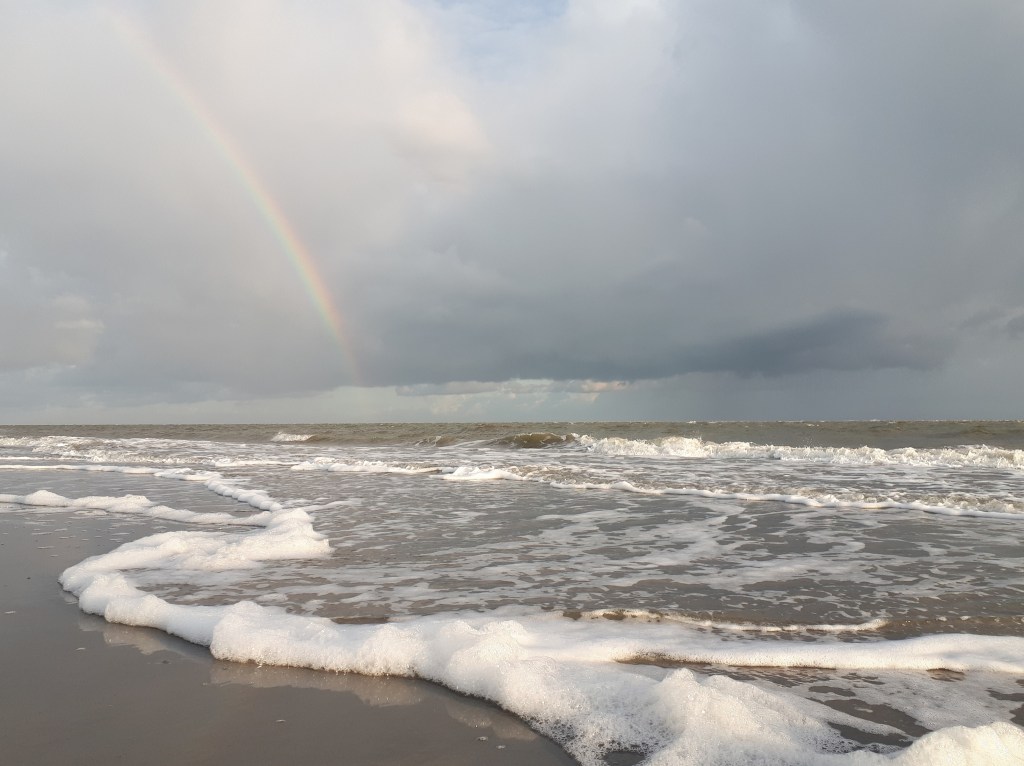
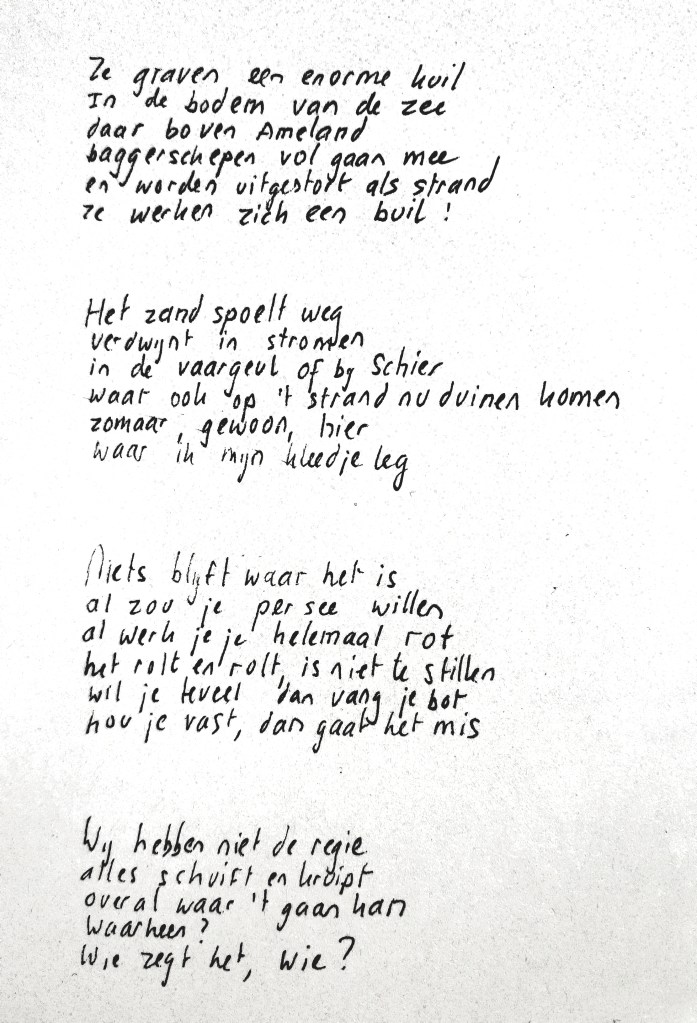
Alles beweegt. Vooral zand, water en wind. Nu is het zo dat het strand van Ameland steeds in zee verdwijnt. Maar een eiland zonder strand, dat kan niet, vinden de mensen. Het strand geeft het eiland ook extra bescherming. Daarom graven ze zand uit de Noordzee en spuiten het tegen het eiland aan. Elke keer opnieuw, want steeds weer verdwijnt het. Hoe? Waarheen….?

.

Everything moves. Especially sand, water and wind. Now it is the case that the beach of Ameland keeps disappearing into the sea. But people think an island without a beach is impossible. A bigger beach is also safer. That is why they dig sand from the North Sea and spray it against the island. Every time again, because it disappears again and again. How? Where to …. ?

De gevolgen van zandwinning op de Noordzee. Er is een toenemende vraag naar zand en steeds minder aanbod. Onze Noordzee is een zandwinningsgat. Vaargeulen worden dieper en breder. Het vele graven en baggeren blijft niet zonder gevolgen. Het is een vloek voor het bodemleven en het doet stromingen van koers veranderen. https://www.waterforum.net/onderzoek-naar-effect-grootschalige-zandwinning-op-noordzee/

Opnieuw delen van het strand van Ameland weggespoeld – https://nos.nl/l/2457956

.

.

.

.

Vluchten voor de hordes . . .Run from the hordes

.

.

Liever luisteren? Klik op de knop onderaan de tekst.

You can find the english translation underneath.

.

Aan de overkant van de sloot loopt een man. Zo te zien is het Will, de man op de motor, met het tentje. “Hoi!” roept hij en steekt zijn hand op. Ik loop over het veld naar hem toe. “Mag ik nu even bij je kijken?” vraagt hij. Dat is goed en we lopen een rondje. Ik laat hem alles zien, mijn woonwagen, de kas, de kleine wildernis eromheen. “Zo, wat een mooi stekkie heb je zeg, dit is nogal wat voor een stadse jongen als ik.” Ik lach. “Is dat zo? Waar kom je vandaan?” Hij vertelt dat hij kapper is. Hartje centrum, op een hoekje van de negen straatjes in Amsterdam. “Ik zit nu tussen de toeristen. Het zijn er 19 miljoen.” Mijn ogen vallen uit de kassen. “In heel Nederland toch zeker?” vraag ik verbijsterd, maar ik weet eigenlijk het antwoord al. “Nee, alleen in Amsterdam.”
“Meer toeristen in Amsterdam dan inwoners in heel Nederland?” stamel ik terwijl ik hem aankijk.
“Ja. Sinds corona zijn er enorm veel vreettenten bijgekomen. Daar staan nu enorme rijen voor.” Ik knik. “Ik was in Leiden, daar was het net zo. Iets minder druk dan Amsterdam waarschijnlijk.”
Hij staart over het weiland, zijn gedachten gaan naar de stad die hem zo vertrouwd is. “Om het weekend moet ik er echt uit, met de motor. Anders word ik gek. Naast mij zit nu ook een afhaaltent. Ik heb er een touw voor gespannen. Er staat soms een rij van wel vijfentwintig mensen. Ze krijgen daar een Lebanese pannekoek.” Hij maakt een gebaar met twee handen alsof hij een dikke flap in zijn mond propt. “Of ze kopen alleen een kop koffie, in karton. In de rij staan voor een bekertje koffie! Ik sta nooit in de rij.”
“Nee, ik ook haast nooit.” Zeg ik. Ik ben nog steeds verbijsterd. Ik wist er wel van, de overlast van toerisme in Amsterdam, maar nu ik het uit eerste hand hoor, maakt het wel indruk. Wat is er nou voor lol aan? Wat moeten die hordes daar? Het zijn vooral jongelui, lees ik later. Tiktok influencers maken een filmpje en dan komen ze met bakken tegelijk aanzetten. Sommige ondernemers verdienen er schatten aan. De straten liggen vol met troep. En gewone ondernemers, zoals kapper Will, dragen de lasten. “Ik doe dit al twintig jaar,” zegt hij. “Ik ben waar ik ben. Mijn huis is 150 meter lopen.”
“Zo hoort het te zijn, vind ik.” Ik kijk hem aan. “Dat je bent waar je bent, en niet almaar heen en weer hoeft. Maar het word steeds moeilijker om te zijn waar je bent. En dat je op de vlucht moet omdat het thuis niet uit te houden is, dat is bizar. Omver gelopen door toeristen! Krijg nou wat!”
“Ja, na corona is het allemaal veel erger geworden.” zegt hij.

Ik kijk over de stille wei. Hoe zal dit verder gaan? Van welke ontwikkelingen zullen we nog getuige zijn? Ik blijf toch maar waar ik ben. Beter. Ook al is dat ook niet altijd makkelijk. Er is al onrust genoeg. Kapper Will staat nog steeds naast me.
“Ik ga weer verder,” zegt hij. “Eens kijken of mijn maat al wakker is. Dat is toch zo’n langslaper! Nou tot kijk hè! Ik kom hier wel weer terug. Dat doe ik al jaren.”
“t Ga je goed!” lach ik en draai me om, om terug te lopen. Terug naar mijn stekkie.

.

Run from the hordes

A man is walking on the other side of the ditch. Looks like it’s Will, the man on the bike, with the tent. “Hi!” he shouts and raises his hand. I walk across the field to him. “Can I come to see your place now?” he asks. That’s good and we’re going for a walk. I show him everything, my very tiny house, the greenhouse, the small wilderness around it. “Well, what a nice place you have, this is quite a bit for a city boy like me.” I smile. “Is that right? Where do you come from?” He tells that he is a hairdresser. In the heart of the center, on a corner of the nine streets in Amsterdam. “I am among the tourists now. There are 19 million of them.” My eyes pop out of their sockets. “In the whole of the Netherlands, you mean?” I ask in bewilderment, but I actually already know the answer. “No, only in Amsterdam.”
“More tourists in Amsterdam than residents in the whole of the Netherlands?” I stammer as I look at him.
“Yes. And since corona, a lot of food tents have been added. There are now huge queues for that.” I nod. “I was in Leiden, it was the same there. A little less busy than Amsterdam, probably.”
He stares across the meadow, his thoughts turn to the city so familiar to him. “Every other weekend I really have to get out, with the motorcycle. Otherwise I get mad. There is also a takeaway tent next to me. I stretched a rope for it. Sometimes there is a queue of up to twenty-five people. They get a Lebanese pancake there.” He makes a two-handed gesture as if he were stuffing a fat flap in his mouth. “Or they just buy a cup of coffee, in cardboard. Standing in line for a cup of coffee! I never stand in line.”
“No, I hardly ever.” I say. I am still baffled. I knew about it, the nuisance of tourism in Amsterdam, but now that I hear it first hand, it makes an impression. What’s the fun in that? What are those hordes doing there? They are mainly young people, I read later. Tiktok influencers make a video and then they come up with buckets at the same time. Some businesspeople make money from it. The streets are full of junk. And ordinary entrepreneurs, such as hairdresser Will, bear the burden. “I’ve been doing this for twenty years,” he says. “I am where I am. My house is 150 meters away.”
“That’s how it should be, I think. That you are where you are, and don’t have to go back and forth all the time. But it’s getting harder and harder to be where you are. And that you have to flee because you can’t bear it at home, that’s bizarre. Run over by tourists! What the hell!” “Yes, after corona it all got much worse,” he says. I look across the silent meadow. How will this continue? What developments will we witness? I’ll just stay where I am. Better. Even if that is not always easy. There is already enough unrest.
Will is still standing next to me. “I’m moving on,” he says. “Let’s see if my buddy is awake yet. That’s such a long sleeper! Well see ya! I’ll be back here. I’ve been doing that for years.”
“Go well!” I laugh and turn to walk back. Back to my hideaway.

.

Foto: Dimhou van Pixabay.