
Alles begint en eindigt bij het parkeren van je auto.
.
.
Liever luisteren? Klik op de knop onderaan de tekst.
Do you like to read the ENGLISH translation? Click on the button underneath.
Vanuit mijn huis kan ik het net zien, tussen alle begroeiing door. Het veld, de sloot, met de rietkraag eromheen, en het weiland erachter. Het weiland in de zomer is anders dan in de winter. In de winter is alles verlaten. Het enige wat je hoort is het gekwetter van spreeuwen en het staccato geroep van de kramsvogels wanneer ze je zien. Het geluid van hun vleugels, wanneer ze massaal opvliegen. In de zomer zijn de kramsvogels weg. Andere vogels trekken zich terug op andere weiden, die helaas niet biologisch zijn en lang niet zo onberoerd als de onze. Voor onze boer is de wei om te hooien en wilde bloemen te laten groeien. Voor de weekendgasten, op weg naar hun feestje, is het vooral een lege ruimte. Wat doe je daarmee? Natuurlijk, een balletje trappen. Maar in de eerste plaats: je auto neerzetten. Of je nou links stemt of rechts, Groenlinks of BBB, bijna iedereen doet het. Gewoontes zijn hardnekkig. Ik denk: Als we het in deze oververhitte wereld anders willen, zullen we ergens moeten beginnen. Verandering van gewoontes.
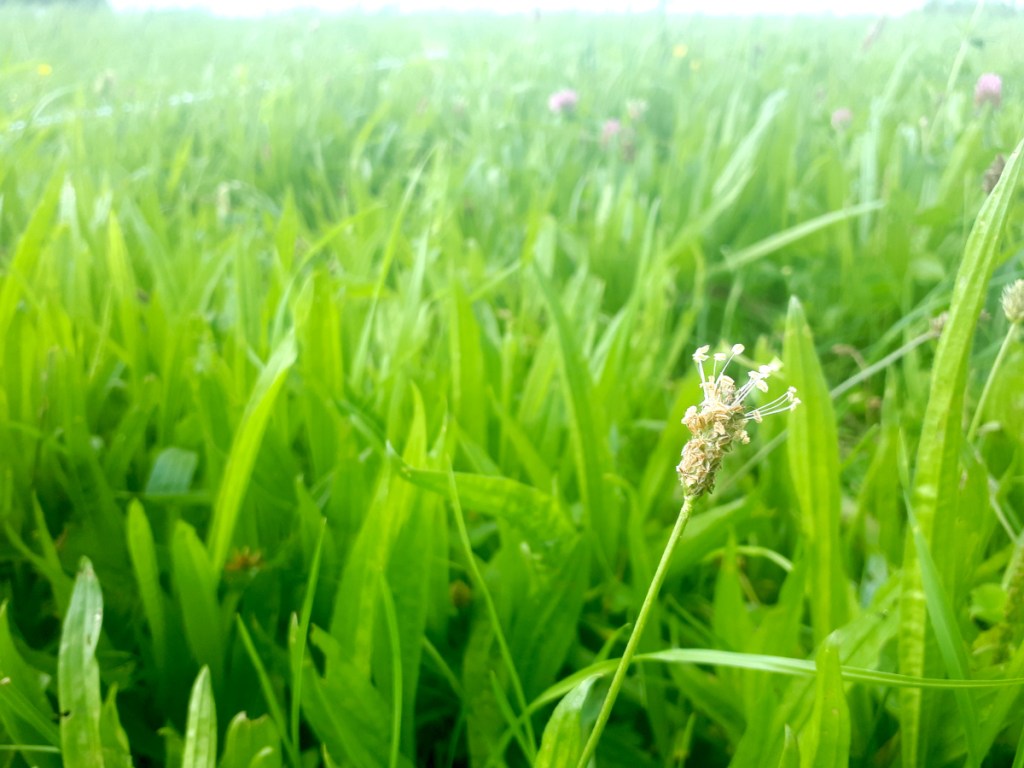
Wanneer ik net mijn huis op orde heb, komt de eerste auto aanrijden. Hij parkeert achter de sloot met een snelle draai in. Het is het laagste stuk. Als het winter was, had hij nu vastgezeten. Het heeft nu ook veel geregend, maar zompig is het nog niet. Ik kijk er goed naar en realiseer me iets. Op die plek groeit mijn thee! Smalle weegbree is het, voor de luchtwegen. Het staat op een bijzonder plekje. Nadat een dampendhete berg bladcompost de hele grasmat had verschroeid, was het enige wat overleefde dit zaad. Het zaad van de weegbree. Nu het staat daar, in een mooie cirkel, dicht op elkaar, zonder ook maar één grassprietje ertussen. Ik ben er blij mee. Ik loop erheen en zie inderdaad een spoor, dwars erdoorheen. De automobilist had er zeker zin in, dat feestje. Hij is met een vaartje doorgeschoten in zijn achteruit, een heel eind het weiland op.
Ik loop naar de kampeerders. Er zijn er al een paar bezig hun tent op te zetten. Hun jonge stemmen klinken vrolijk en opgewekt. Er staat zachtjes een muziekje aan, rustige lichtvoetige jazz is het. “Hoi!” roep ik “Er is iemand door mijn thee gereden.” Ik kijk verkennend rond. De jongen die het laatst aankwam komt meteen naar me toe. Hij loopt met me mee en geïnteresseerd ziet hij wat hij eerst niet zag. “Goh,” zegt hij “Ja zeg! Ik denk dat de anderen dit ook niet zien. Ik zal het omheinen, met een touw.” Hij gaat meteen aan de slag. Ondertussen stelt hij allerlei vragen, hoezo die kruiden op deze plek, en helpt het inderdaad zo goed voor de luchtwegen. Met plezier geef ik antwoord. Maar zijn auto staat nog steeds midden in de wei. Ik wijs hem op een hoger stuk, vlak langs de weg. “Daar is beter. Daar parkeren vaker auto’s” zeg ik “Als je hem midden op het veld laat staan, dan zetten de anderen hun auto’s er straks naast. Dan ben jij het voorbeeld. Beter van niet.” Hij snapt het meteen en zet zijn auto neer op de gewezen plek.
Het leven bestaat uit talloze gewoontes. Met elkaar maken we ons bestaan op aarde, zoals het is. Inmiddels erkent iedereen dat het anders moet. Dat we de natuur meer plek moeten geven, gewoon, waar we wonen. Steeds meer mensen begrijpen hoe belangrijk een losse humusrijke bodem is, als basis voor al het leven. De meeste snappen het wel, maar hoe pas je dat toe? Je doet wat je doet en de agenda zit vol. Je schiet van het één naar het andere, en schiet gauw door. Dat is vergeeflijk, maar daar begint het wel mee. De verandering.
Later die dag kom ik er weer terug. Ik knip de platgereden blaadjes af om te drogen. Vertederd kijk ik naar het witte touw, dat mijn thee omheint. En naar de drie geparkeerde auto’s, op het hoge stuk, vlak langs de weg. Die jonge lui zijn toch niet gek! Opnieuw denk ik, wie weet kan het. Wie weet komt het toch, uiteindelijk, allemaal goed.
.
.
A Way from the habbit
From my house I can just see it, through all the vegetation in front of the window. The field, the ditch, with the reed around it, and the meadow behind it. The pasture in the summer is different than in the winter. In winter everything is deserted. All you hear is the twitter of starlings and the staccato calls of the fieldfares when they see you. The sound of their wings, when they take flight. In the summer the fieldfares are gone. Other birds retreat to other pastures, which unfortunately are not organic and not nearly as untouched as ours. For our farmer, the meadow is for making hay and growing wild flowers. For the weekend guests, on their way to their party, it is mainly an empty space. What do you do with that? Of course, kick a ball. But first of all: park your car. Whether you vote left or right, Groenlinks or BBB, almost everyone does. Habits are persistent. I think: If we want to change things in this overheated world, we have to start somewhere. Change of habits. Everything starts and ends with parking your car.
When I’ve just got my house in order, the first car drives up. He parks behind the ditch with a quick turn. It’s the lowest part. If it were winter, he would be stuck by now. It has also rained a lot now, but it is not soggy yet. I look closely and realize something. That’s where my tea grows! Narrow plantain it is, for the respiratory health. It is in a special place. After a steaming hot mound of leaf compost scorched the entire turf, the only thing that survived was this seed. The seed of the plantain. Now it’s there, in a nice circle, close together, without a single blade of grass in between. I’m happy with it. I walk towards it and indeed see a track, right through it. The motorist was certainly looking forward to that party. He sped along in reverse, a long way out into the pasture.
I walk to the campers. Some of them are already setting up their tents. Their young voices sound cheerful. There is soft music playing, quiet light-footed jazz it is. “Hi!” I shout “Someone drove through my tea.” I look around. The boy who arrived last comes straight to me. He walks with me and with interest he sees what he didn’t see before. “Gosh,” he says “Yes! I don’t think the others see this either. I will fence it in with a rope.” He immediately gets to work. In the meantime he asks all kinds of questions, why those herbs in this place, and does it indeed help so well for the airways. I will answer with pleasure. But his car is still in the middle of the meadow. I point him to a higher area, close to the road. “There is better. Cars park there more often” I say “If you leave it in the middle of the field, the others will park their cars next to it. Then you are the example. Better not.” He immediately understands and parks his car at the designated spot.
Life consists of countless habits. Together we make our existence on earth, as it is. Everyone now recognizes that things have to be done differently. That we should give nature more space, just where we live. More and more people understand how important a loose, humus-rich soil is, as the basis for all life. Most get it, but how do you apply it? You do what you do and the agenda is full. You shoot from one thing to the next, and quickly shoot through. That’s forgivable, but that’s where it starts. The change.
I’ll be back later that day. I cut off the flattened leaves to dry. Endeared, I look at the white rope that surrounds my tea. And to the three parked cars, on the high part, close to the road. Those young people aren’t crazy! Again I think, who knows. Who knows, maybe it will all work out in the end.
 Alowieke
Een gedachte over “Weg van de gewenning. . . (A Way form the habbit)”