
Een verhaal over de tegenstelling tussen efficienty en verwondering, of ontzag.
.
.
Liever luisteren? Klik op de knop onderaan de tekst.
You can find the ENGLISH translation underneath.
“Als ik dan elke dag riet aan het snijden ben. . .” begin ik te vertellen. . . Naast me, op de lange bult, staat een bezoeker. Hij kwam vooral omdat hij hier bessen had gezien. Of hij die mocht plukken. Dat vond ik prima, maar dan wel met een verhaal erbij. Tenslotte is dit geen Eetpad, maar allereerst een Verhalenpad. “dan voel ik me zo klein in dit landschap” vervolg ik mijn verhaal. “Alles zou riet zijn, zonder ons. Eindeloos, tot de horizon. Sta ik daar met mijn sikkel.” Maar de man is niet gevoelig voor poëzie. “Ja.” Hij glimlacht geruststellend. “Maar dat hoeft niet meer. Daarvoor hebben we machines.” Ik schud mijn hoofd. “Dat is niet wat ik bedoel. Als je met de hand werkt, met je voeten op de klei, dan voel je je veel meer verbonden met het land.” Zijn mond hangt een beetje open. “O..” zegt hij. We lopen een stukje verder, want hij ziet een bessenstruik. Gretig begint hij te plukken. “We moeten meer bessen eten,” zegt hij kauwend. Ik kijk het een poosje aan. “Laat je nog wat over?” vraag ik dan droogjes. Hij schrikt op. “O ja”. Dan vertel ik verder over het werk. “Ik hak vooral riet met de sikkel. Dat is wel doorwerken, al die meters.” Hij kijkt me vaderlijk aan. “Je kan ook een bosmaaier gebruiken,” licht hij me voor. Maar ik ben zeer beslist in mijn antwoord. “O nee. Geen bosmaaier hier. Een bosmaaier maakt blind en doof. Op een Verhalenpad leer je juist verhalen zien. En te horen. Ik kijk liever naar een broedende vogel in plaats van per ongeluk zijn nest stuk te raggen.” Hij kijkt schuldbewust. Alsof hij het persoonlijk was, die dat deed. Alsof hij het eigenlijk niet goed mag keuren, dat door mechanisatie zoveel over het hoofd wordt gezien. Maar ja. Het moet wel. Denkt hij.
De volgende dag sta ik daar weer. Maar dan alleen. Het is nog vroeg, half acht in de ochtend. De zon is nog niet achter de sluierwolken vandaan gekomen. Ik houd van die koelte. Straks zal het vast weer broeierig worden. In mijn hand heb ik dit keer de heggenschaar. Daarmee kan ik preciezer werken. Op mijn hurken waggel ik door het gras om beginnende rietstengeltjes kort en klein te maken. Het gaat toch verrassend snel. Ik kom bij een hoger bosje, dat ik rond een stokroos gelaten heb. De lange stengels zijn omgewaaid door de storm, maar hij bloeit gewoon door, op de grond. Mooie grote bloemen, vol hommels, een zoemend bloemenbosje is het. Steeds dichter kom ik bij de stengels. Het geluid van de heggenschaar is het enige wat ik hoor. Het is windstil en zelfs de karekiet in het riet houdt zijn snavel. Tik tik, doet de schaar. Maar dan ineens krioelt het, daar waar eerst beschutting was van gras en klein riet, vlak achter de bloemen. Nu is het er kaal. Mieren lopen kris kras door elkaar, en beginnen eieren naar buiten te brengen. Een bruinoranje nachtvlinder hipt ongelukkig rond. Hij springt op mijn toegestoken vinger. Ik heb zijn linker vleugel afgeknipt. Stom. Ik wist het immers best, dit bosje moest ik zo laten. Ik ben te ver gegaan.
Ik probeer dit steeds te voorkomen. Al werkend blijf ik kijken. Ik ziet de hommel, die uit zijn hol komt en trek me respectvol terug. Er is immers genoeg werk. Dus ik ga verder bij de hazelaars, brandnetels uittrekken, gele wortels met kluiten eraan. Ik schud ze uit en gooi ze op een hoop. De brandnetels voor me bloeien nog niet. Ze zijn fris en groen, de blaadjes. Dan zie ik opnieuw die kleine zwarte bolletjes op het blad. Het zouden korrels aarde kunnen zijn, die ik daar rondgestrooid heb. Maar ze zijn perfect rond van vorm en liggen op gelijke afstand van elkaar. Dat trekt mijn aandacht. Even verderop zie ik een kleine zwart met grijs gestreepte rups. Ah, het zijn dus toch eitjes! Opnieuw stop ik. Ik heb immers al een heel stuk gedaan, de rest mag blijven voorde vlinders . Ik loop terug. Het is tijd voor pauze. Bij de entree staat een bos verdwaalde oeverplanten, die zich als lange tongen achter de haag verzamelen, in de vochtige greppel. Ik weet dat daar in die buurt een kleine hommel woont, onder het pellet dat daar ergens ligt te rotten. Ik laat het. Al betekent het meer werk, om het steeds weer te begrenzen. Op een dag zal dat steeds minder worden. Op een dag.
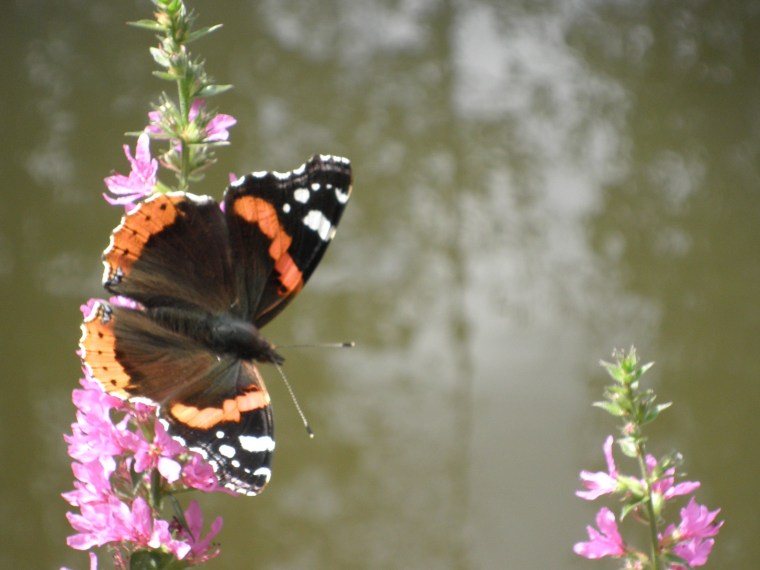
Even later zit ik tevreden in mijn kas koffie te drinken. Voor de deur loopt een stel meiden langs, het zijn dertigers. Hun tentjes staan hier op het veld en ze zijn op weg naar mijn buurvrouw. Glimlachend kijken ze bij mij naar binnen. Ik weet, het ziet er knus uit. Ik roep naar ze: “Denken jullie aan de vlinder??” Want natuurlijk, ik heb het ze verteld. Elke dag om dezelfde tijd zit er een Atalanta te zonnen op het zandpaadje. “Ja!” roept de een, “We lopen er steeds met een grote boog omheen!” Mijn glimlach verbreed zich tot een grijns. Glanzend kijk ik ze na. Er is toekomst.
.
.
THERE IS FUTURE.
A story about the contradiction between efficiency and wonder, or awe.
.
“When I am cutting reeds every day. . .” I start my story. Next to me, on the long hump, is a visitor. He came mainly because he had seen berries here. If he could pick it. I thought that was fine, but with a story to go with it. After all, this is not a Food Path, but first and foremost a Story Path. “I feel so small in this landscape” I continue. “Everything would be reeds without us. Endless, to the horizon. And I stand here with my sickle.” But the man is not sensitive to poetry. “Yes.” He smiles reassuringly. “But that is no longer necessary. We have machines for that.” I shake my head. “That’s not what I mean. When you work by hand, with your feet on the clay, you feel much more connected to the land.” His mouth hangs open a little. “Oh…” he says. We walk a little further, because he sees a berry bush. He eagerly begins to pick. “We need to eat more berries,” he says, chewing. I watch it for a while. “Do you leave some left?” I ask dryly. He startles. “Oh yeah”. Then I tell him more about the work. “I mainly chop reeds with the sickle. That means continuing to work, all those meters.” He looks at me paternally. “You can also use a brushcutter,” he explains. But I am very firm in my answer. “Oh no. No brushcutter here. A brushcutter makes blind and deaf. On a Story Path you learn to see stories. And to hear. I’d rather watch a nesting bird than accidentally destroy its nest.” He looks guilty. As if it was him personally who did that. As if he shouldn’t actually approve of the fact that so much is overlooked due to mechanization. But yeah. It has to, he thinks.
The next day I am there again. But then alone. It is still early, half past eight in the morning. The sun has not yet come out from behind the veil clouds. I like that coolness. Soon it will be sweltering again. In my hand I have the hedge trimmer this time. This allows me to work more precisely. On my haunches, I waddle through the grass to cut budding reed stems short and small. It goes surprisingly fast. I come to a higher bush, which I left around a hollyhock. The long stems have been blown over by the storm, but it continues to bloom on the ground. Beautiful large flowers, full of bumblebees, it is a humming bunch of flowers. I get closer and closer to the stems. The sound of the hedge trimmer is all I hear. There is no wind and even the reed warbler keeps its beak in the reeds. Tap tap, do the scissors. But then suddenly it is teeming there, where there used to be shelter of grass and small reeds, just behind the flowers. Now it is bare. Ants criss-cross each other, and begin to bring out eggs. A brown-orange moth hops around unhappily. He jumps on my stabbed finger. I cut off his left wing. Stupid. After all, I knew best, I had to leave this bush as it was. I’ve gone too far.
I always try to avoid this. I keep watching while working. I see the bumblebee coming out of its hole and respectfully withdraw. After all, there is enough work. So I move on to the hazels, pull up nettles, yellow roots with clods on them. I shake them out and toss them in a pile. The nettles in front of me haven’t bloomed yet. They are fresh and green, the leaves. Then I see those little black dots on the leaf again. It could be grains of earth that I scattered there. But they are perfectly round in shape and are equidistant from each other. That catches my attention. A little further on I see a small black and gray striped caterpillar. Ah, so they are eggs! Again I stop. After all, I’ve already done a lot, the rest can stay for the butterflies. I walk back. It’s time for a break. At the entrance there is a bunch of stray shore plants, which gather like long tongues behind the hedge, in the low moist ground. I know there’s a little bumblebee living in that neighborhood, under the pellet that’s rotting there somewhere. I leave it. Although it means more work to limit it again and again. One day it will become less and less. One day…
A little later I am satisfied in my greenhouse drinking coffee. A group of girls walk by in front of the door, they are in their thirties. Their tents are here on the field and they are on their way to my neighbor. They smile at me. I know, it looks cozy. I call out to them: “Do you remember the butterfly??” Of course, I told them. Every day at the same time there is an Atalanta sunbathing on the sandy path. “Yes!” shouts one, “We always walk around it!” My smile widened into a grin. I stare at them gleefully. There is future.

 Alowieke